
Jet Washing vs Pressure Washing: Is There a Difference?
Quick answer: In everyday UK usage, jet washing and pressure washing mean the same thing — both describe cleaning outdoor surfaces with a powerful jet of pressurised water. "Jet washing" is the more traditional British term, while "pressure washing" has carried over from American usage and technical contexts. The real distinction most people are actually searching for is between cold water and hot water cleaning, which is where genuine differences in results begin to show.
If you've been trying to book someone to clean your driveway, patio, or the green streaks creeping up your render, you've probably noticed that different companies use different words for what looks like the same job. One quote says "jet washing," another says "pressure washing," and a third throws in "power washing" for good measure. It's easy to assume you're comparing three different services when you're really just looking at three different labels — and that confusion isn't your fault, because even within the trade, the terminology isn't used consistently.
This guide sorts out what's actually going on, so you know what you're booking and what to expect from it. For a deeper look at the process itself, our ultimate guide to jet washing covers surfaces, methods, and results in full.
Are jet washing and pressure washing the same thing?
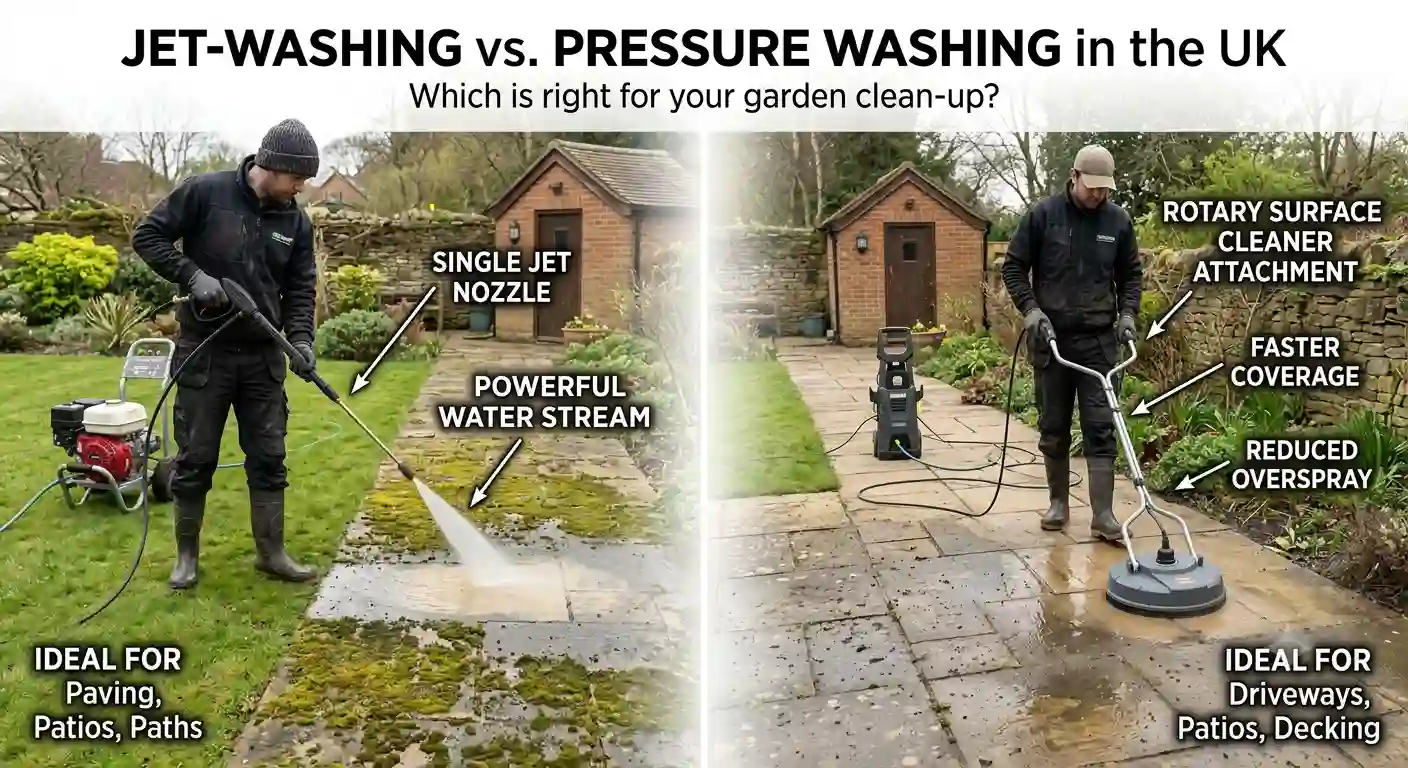
Yes — in the UK, jet washing and pressure washing are the same thing. Both terms describe a machine that pressurises water and forces it through a nozzle at high speed, using that force to physically strip away dirt, grime, moss, and algae from a surface.
"Jet washing" has traditionally been the go-to British phrase — it comes from the idea of a "jet" of water blasting away dirt. "Pressure washing" is the term you'll see more in American contexts, and it's become increasingly common in the UK too, particularly in formal quotes and technical documentation. Some regions lean more one way than the other; "jet washing" tends to come up more in everyday conversation across parts of the South East, while trade documentation often defaults to "pressure washing" regardless of where the company is based.
If a company describes their service as jet washing and another calls it pressure washing, there's a good chance they're offering exactly the same thing — just using a different word for it.
Jet washing, power washing, or soft washing: where the confusion comes from
The genuine mix-up happens because several terms get used in the same conversation, and they don't all describe the same level of service:
| Term | Water temperature | Pressure level | Best for |
|---|---|---|---|
| Jet washing / pressure washing | Cold (mains) | High | Driveways, patios, paths, general dirt and moss |
| Power washing | Hot (typically 50–80°C) | High | Grease, oil, heavy contamination, commercial surfaces |
| Soft washing | Cold | Low, with biocide treatment | Roofs, render, delicate or older brickwork |
So while "jet washing" and "pressure washing" are essentially synonyms, "power washing" and "soft washing" describe genuinely different approaches — and this is worth understanding before you book anything.
Cold water vs hot water: the difference that actually matters
The most meaningful technical distinction in surface cleaning is not jet washing vs pressure washing — it's cold water vs hot water. Most standard jet washers and pressure washers use cold water straight from the mains, pressurised through the machine. This works well for loose dirt, mud, dust, and general surface grime — the everyday build-up on a driveway or patio.
Hot water machines, sometimes marketed as "power washers," heat the water before it hits the surface — typically somewhere in the range of 50–80°C. That extra heat makes a genuine difference when dealing with grease, oil, or heavy biological growth like algae and moss, because heat helps break down these substances in a way that pressure alone doesn't manage as effectively.
For a typical UK driveway or patio covered in general dirt, moss, and the occasional oil stain, cold water cleaning with the right pre-treatment usually does the job perfectly well. Hot water becomes genuinely useful for tougher jobs — commercial kitchen extraction systems, forecourts with heavy oil contamination, or industrial surfaces where cold water alone struggles to shift the grime.
Cold water jet washing is better suited for standard residential driveways, patios, and paths with general dirt and moss. Hot water power washing works best when dealing with oil, grease, or ingrained biological contamination on commercial or industrial surfaces.
Does PSI actually matter?
PSI (pounds per square inch) measures the water pressure a machine produces — but higher PSI is not always better. Domestic units typically sit somewhere between 1,000 and 4,000 PSI, and it's tempting to assume that a higher number automatically delivers better results.
It doesn't, necessarily. A higher PSI setting is effective for stubborn concrete stains and heavily soiled surfaces, but it's also more likely to cause damage on delicate materials — old brickwork, timber decking, painted render, and softer stone can all be scored or stripped by a setting that's too aggressive.
A competent professional will adjust the pressure and nozzle to suit the surface, rather than running everything at maximum strength. This is one of the genuine advantages of hiring an experienced contractor rather than renting a machine and guessing the right settings.
When is soft washing the better option?
Soft washing is the correct approach for roofs, render, and delicate brickwork — not standard jet washing. High-pressure water can damage roof tiles, render, and older masonry, even at a gentler pressure setting.
Soft washing uses low pressure combined with a biocide treatment that kills algae, lichen, and moss at the root, rather than physically blasting the growth off the surface. This is a meaningful difference: standard jet washing removes visible growth without treating what's causing it, while soft washing addresses the underlying biology, which typically means results last considerably longer.
If you're dealing with green staining on a roof or render and you're unsure whether it needs a jet wash or a soft wash, it's worth asking directly when getting quotes. A reputable company should be able to tell you which approach suits the surface, rather than defaulting to whichever service they happen to offer.
Which method suits which surface?
| Surface | Recommended method |
|---|---|
| Concrete or block-paved driveway | Cold water jet washing with pre-treatment |
| Patio (stone or slabs) | Cold water jet washing, adjusted pressure |
| Timber decking | Low-pressure jet washing, wide nozzle |
| Oil-stained forecourt or garage floor | Hot water power washing |
| Render or cladding | Soft washing |
| Roof tiles | Soft washing |
| Older or period brickwork | Soft washing or specialist low-pressure clean |
How much does jet washing cost in the UK?
Professional jet washing typically costs £3–£7 per square metre in the UK, which works out at roughly £60–£120 for a single-car driveway and £100–£250 for a double. Patios usually fall in the £80–£200 range depending on size and condition.
| Job | Indicative cost |
|---|---|
| Single-car driveway (up to 20m²) | £60–£120 |
| Double driveway (20–50m²) | £100–£250 |
| Patio | £80–£200 |
| Oil stain treatment (add-on) | £20–£50 |
Condition matters more than size — years of ingrained moss or oil takes longer to shift than general dirt. Prices in London tend to sit toward the top of these ranges; if you're in the capital, our London jet washing team can give you an exact figure for your postcode. For anywhere else in the UK, request a free quote and we'll price the job from a couple of photos.
What to ask when booking a jet washing or pressure washing service
In practice, don't worry too much about whether a company calls their service "jet washing" or "pressure washing" — treat them as the same thing unless told otherwise. What's actually worth asking about is:
- Cold water or hot water? — particularly relevant if you're dealing with oil staining, grease, or heavy contamination
- Is the surface suitable for standard pressure washing, or does it need a softer approach — especially on render, older brickwork, or roof tiles
- What PSI and nozzle settings will be used for your specific surface, particularly if you have period brickwork, delicate paving, or exposed pointing
A driveway covered in everyday dirt and moss is a straightforward job for cold water jet washing. A commercial forecourt with years of oil ingrained into the concrete is a different challenge, and hot water cleaning will likely deliver better results. Meanwhile, a roof or render job may not need pressure at all — it may need a soft wash and the patience to let the treatment do its work over several days. If you'd rather skip the guesswork entirely, our professional jet washing service assesses the surface first and matches the method to it.
A quick note on DIY pressure washing
Pressure washers are more capable of causing damage than most people expect — both to surfaces and to the person operating them. Getting too close with too much pressure can strip paint, gouge softer materials, and force water into places it shouldn't go: behind render, under roof tiles, into brick joints.
If you're dealing with anything beyond a straightforward driveway or patio, it's worth getting a professional assessment before hiring a machine — particularly on period properties or anything with delicate pointing, render, or older masonry.
Frequently Asked Questions
Is jet washing the same as pressure washing in the UK?
Yes. In everyday UK usage, jet washing and pressure washing mean the same thing — both describe cleaning outdoor surfaces using pressurised water. "Jet washing" is the more traditional British term, while "pressure washing" is now equally common, particularly in trade quotes and technical documentation.
What is the difference between pressure washing and power washing?
Strictly speaking, power washing uses heated water — typically between 50–80°C — while standard pressure washing or jet washing uses cold mains water. The heat makes power washing more effective against grease, oil, and stubborn biological build-up, but cold water cleaning is perfectly adequate for most residential driveways and patios.
Can I jet wash my roof or render safely?
Generally, no. High-pressure water can damage roof tiles, render, and older brickwork. These surfaces are usually better suited to soft washing, which uses low pressure combined with a specialist biocide treatment to kill moss and algae at the root without physically stripping the surface.
Does a higher PSI always mean better cleaning results?
Not necessarily. Higher pressure is useful for heavily soiled concrete or stubborn stains, but it increases the risk of surface damage on delicate materials such as timber, older brick, or painted render. The right PSI depends on the surface being cleaned, not just the power of the machine.
How long do the results of jet washing last?
Results vary depending on the surface, its environment, and the cleaning method used. Standard cold water jet washing removes visible dirt and growth but does not treat the underlying cause, so moss and algae typically return within one to two years in damp UK climates. Soft washing, which uses a biocide treatment, tends to deliver longer-lasting results — often three to five years on roofs and render — because it addresses the biological growth at the root.