
Is in-house cleaning really cheaper? The hidden costs businesses miss
In-house cleaning often appears cheaper on paper, but according to the International Facility Management Association (IFMA), in-house cleaning operations can cost businesses around 25% more than outsourcing to a professional cleaning provider. The gap comes almost entirely from costs that most businesses fail to account for until they're already paying them.
This guide breaks down the real cost of in-house cleaning staff vs commercial cleaning contractors, so business owners and decision-makers can make an informed, numbers-based choice.
Where the 25% Gap Actually Comes From
- Employer National Insurance and minimum pension contributions alone typically add around 14-17% on top of a cleaner's headline salary, before any other costs are counted.
- Holiday pay, sick pay, equipment, and ongoing management time (rostering, quality checks, cover) stack on top of that statutory gap.
- Staff turnover and absence are the most consistently underestimated cost of all, since every sick day or resignation becomes the business's own problem to solve.
- Outsourcing bundles staffing risk, equipment, compliance, and guaranteed cover into one predictable fee, which is why it particularly suits mid-size and multi-site businesses.
The real cost of in-house cleaning vs outsourcing
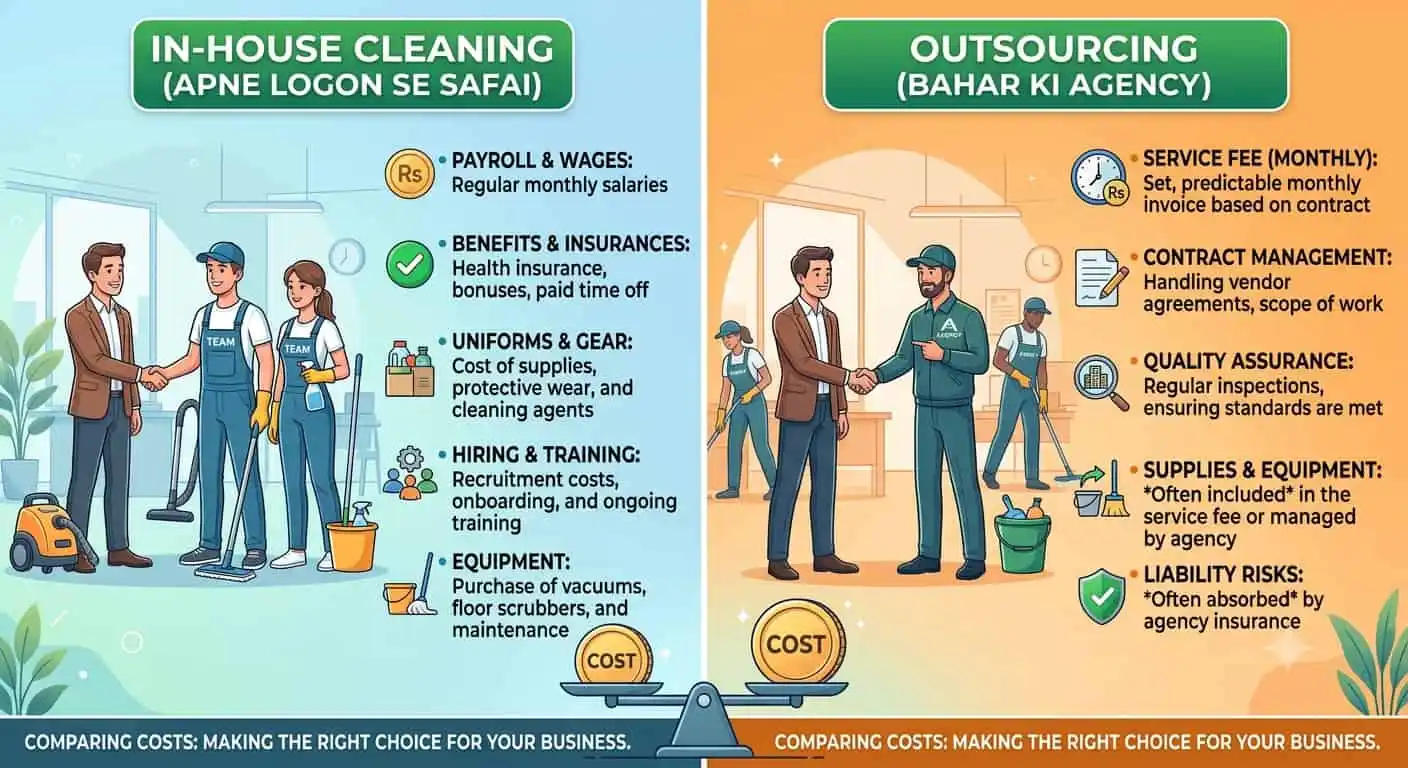
In-house cleaning can run around 25% more expensive overall than outsourcing, once genuine indirect costs are properly accounted for, according to IFMA research. The key cost drivers that tip the balance include:
- Salaries plus statutory add-ons: National Insurance, pension contributions, holiday pay, and sick pay
- Equipment purchasing, maintenance, and replacement
- Internal management time spent on rostering, quality checks, and cover
- Recruitment and training costs every time a cleaner leaves
Outsourced cleaning bundles staffing risk, equipment, compliance, and guaranteed cover into one predictable fee, which is why it tends to suit mid-size and multi-site businesses particularly well. You can see how outsourced pricing typically works once you've made that decision in our walkthrough of the commercial cleaning process.
Why the headline comparison is misleading
It's easy to compare an in-house cleaner's hourly wage against an outsourced contractor's quoted rate and conclude the in-house option is cheaper, since the wage figure is usually the lower number on paper. This comparison misses almost everything that actually determines the real cost of either approach, and it's precisely why so many businesses end up surprised by how their actual spending compares to what they originally budgeted.
A wage is just the starting point. Once you add the layers that come with direct employment, statutory contributions, benefits, equipment, and the ongoing time someone has to spend managing the arrangement, the true cost of in-house cleaning consistently runs higher than the headline hourly rate would suggest, often by a considerable margin.
Hidden costs of in-house cleaning staff
What sits underneath an in-house cleaner's wage
Direct staffing costs extend well beyond the number on a payslip. Employer National Insurance and minimum workplace pension contributions under auto-enrolment obligations typically add around 14-17% on top of base salary alone, before holiday pay and sick pay, both legal requirements, are even factored in.
Equipment is its own ongoing cost line that's easy to underestimate. Vacuum cleaners, mops, cleaning chemicals, and any specialist equipment all need purchasing, maintaining, and periodically replacing, costs that sit entirely with the business when cleaning is handled in-house, rather than being bundled into a contractor's quoted rate.
| Cost category | In-house | Outsourced |
|---|---|---|
| National Insurance and pension | ~14-17% on top of salary | Included in contractor's rate |
| Equipment and consumables | Bought, maintained, and replaced by the business | Bundled into the fee |
| Absence and holiday cover | Business's own problem to solve | Guaranteed cover clause |
| Insurance and liability | Sits with the business as employer | Sits with the contractor |
The management time nobody budgets for
One of the biggest hidden costs of in-house cleaning is internal management time, and it genuinely doesn't show up as a distinct line item on any invoice. Someone within the business still needs to oversee rosters and shift patterns, run quality checks, arrange leave cover, order consumable stock, and manage occupational health and safety compliance.
This management burden compounds fast. A single in-house cleaner might only need light oversight, but managing multiple staff, different shifts, or multiple sites means management time grows considerably faster than the headline staffing cost would suggest.
Why absence and turnover are the real dealbreaker
Cover is one of the most consistently underestimated costs of in-house cleaning, and is widely described as the hidden dealbreaker of the whole arrangement. With in-house staff, every sick day, every period of annual leave, and every resignation becomes a problem the business itself has to solve directly, usually at short notice and often without an obvious solution.
Staff turnover carries a particularly high cost in cleaning roles specifically, where absenteeism and attrition tend to run higher than in many other job categories. Every time an in-house cleaner leaves, the business faces recruitment costs, a training period for whoever replaces them, and a genuine gap in coverage during the transition. These costs rarely get factored into the original decision to hire in-house rather than outsource in the first place.
Benefits of outsourcing commercial cleaning
A contracted cleaning provider handles staffing risk differently, and considerably more predictably.
Predictable pricing: rather than juggling National Insurance, pension obligations, equipment purchasing, sickness cover, and ongoing management time as separate, unpredictable cost lines, a business pays one agreed amount and the contractor absorbs the operational complexity behind it. A fixed monthly or annual cleaning contract is straightforward to forecast.
No staffing risk: a guaranteed cover clause means the outsourced provider, not the client business, is responsible for solving staffing gaps when their own employee is sick or on leave.
Equipment and compliance included: outsourced cleaning contractors typically carry their own insurance, handle COSHH compliance for chemical storage and use, and maintain their own risk assessments and staff training records. These are costs and responsibilities that a business hiring in-house staff has to build and maintain itself.
Liability transfer: if an in-house cleaner is injured, or causes damage while working, the business carries that liability directly as the employer. With a properly contracted outsourced provider, that liability typically sits with the contractor's own insurance and employment arrangements, a genuine risk transfer worth factoring into any honest cost comparison.
Flexibility: a business with fluctuating cleaning needs can typically scale an outsourced contract up or down relatively easily, adjusting frequency or scope as needed. Scaling in-house staffing works considerably less smoothly, hiring an additional cleaner involves full recruitment and onboarding costs, while reducing headcount carries its own complications, from redundancy considerations to practical scheduling difficulties. If you're weighing this up for a Birmingham site specifically, our Birmingham commercial cleaning team can put together a like-for-like cost comparison.
Why businesses miscalculate the cost of in-house cleaning
The most common mistake is treating the hourly wage as the total cost. In reality, wage does not equal total cost. When businesses compare an in-house cleaner's wage directly against a contractor's quoted rate, they're comparing an incomplete figure against a complete one. The contractor's rate already includes insurance, equipment, pensions, sick cover, and compliance. The wage figure includes none of these.
To run the comparison properly:
- Start with the direct salary or contractor quote
- Add National Insurance, pension, holiday pay, and sick pay for the in-house option
- Estimate management time honestly, this is often the single most underestimated figure in the entire comparison
- Factor in equipment costs and a realistic allowance for turnover and recruitment, based on typical patterns in cleaning roles
Once all of these are included, the comparison typically looks considerably different from the initial, misleadingly simple hourly-rate comparison most businesses start with.
When in-house cleaning can still make sense
Outsourcing is not automatically the right answer for every business. Very small operations with a single, stable, long-serving cleaner and minimal complexity in scheduling or compliance can sometimes run in-house cleaning without the hidden costs compounding as significantly as they would for a larger operation.
Businesses with highly specific security requirements, where consistency of the exact same individual having access to sensitive areas matters enormously, sometimes prefer the direct employment relationship that in-house staffing provides, even at a cost premium. This is a legitimate consideration in certain sectors, though it is worth weighing honestly against the genuine cost gap rather than assuming security concerns automatically outweigh the financial difference. This is a separate consideration from very large, complex sites, where our own commercial cleaning cost guide notes the calculation can shift the other way for different reasons, size and complexity of scope rather than staffing stability.
In-house cleaning is better suited for: very small, single-site operations with stable, long-serving staff and minimal compliance complexity. Outsourcing works best for: mid-size businesses, multi-site operations, or any organisation where predictable costs, reliable cover, and reduced administrative burden are priorities.
Making the decision that fits your business
The right choice ultimately depends on your specific circumstances, size, complexity, number of sites, and how much value you place on predictability versus direct control over staffing. For most mid-size and multi-site businesses, the accumulated hidden costs of in-house cleaning tend to make outsourcing the more straightforward and often genuinely cheaper option once everything is properly accounted for.
Smaller, simpler operations may find the calculation closer. What matters most is doing the comparison honestly, with every hidden cost included, rather than defaulting to whichever option looks cheaper on the surface at first glance. If you're ready to find out what outsourcing commercial cleaning could save your business, you can get a like-for-like quote from our team or explore the rest of our commercial cleaning services for a full cost comparison tailored to your site.
Frequently asked questions
Is in-house cleaning really 25% more expensive than outsourcing?
According to IFMA research, in-house cleaning operations can cost around 25% more overall than outsourcing once indirect costs, including National Insurance, pensions, equipment, and management time, are properly factored in, rather than comparing wage against contractor quote alone.
What hidden costs does in-house cleaning carry beyond wages?
National Insurance contributions, pension contributions, holiday pay, sick pay, equipment purchasing and maintenance, and ongoing management time spent on rostering, quality checks, and covering absences all add to the true cost beyond the headline salary figure.
Why is staff absence such a significant cost in in-house cleaning?
Every sick day or resignation becomes the business's own problem to solve, often at short notice. Outsourced contracts typically include guaranteed cover, meaning the provider handles staffing gaps rather than the client business.
Does outsourcing make sense for every type of business?
Not necessarily. Very small operations with a single stable cleaner, or businesses with specific security requirements around consistent staff access, sometimes find in-house cleaning still suits them, even at a cost premium, though it is worth running the full comparison honestly first.
What compliance responsibilities come with hiring in-house cleaning staff?
Businesses employing in-house cleaning staff must maintain their own COSHH documentation, insurance cover, staff training records, and risk assessments. Outsourced providers typically handle all of these as part of their contracted service, removing the administrative and legal burden from the client.
How do I calculate the true cost of an in-house cleaner?
Start with base salary, then add employer National Insurance and pension contributions (typically around 14-17% combined), holiday and sick pay, equipment costs, and an honest estimate of internal management time. Include a realistic turnover and recruitment allowance based on sector averages, not best-case assumptions.