
From first enquiry to ongoing contract: the commercial cleaning process explained
The commercial cleaning process, from first enquiry to a fully running contract, involves considerably more structure than most business owners expect. It includes a detailed site visit, credential checks, a scoped agreement, and an ongoing quality assurance process. Understanding each stage helps set realistic expectations and makes it easier to choose the right provider from the outset.
Booking a commercial cleaning contract for the first time feels genuinely different from arranging a domestic clean, and most business owners aren't entirely sure what to expect once they've made that initial call. What follows is a clear, stage-by-stage breakdown of how the process actually works.
The Journey, Stage by Stage
- A proper first visit involves someone walking the site with you in person, not quoting purely from a phone call or floor plan.
- A reputable provider should produce full insurance without hesitation, typically £1 million minimum public liability cover, with £5 million more common for larger commercial contracts, alongside DBS-checked staff, COSHH compliance, and site-specific risk assessments.
- Many providers offer an initial trial arrangement, commonly around a month, before moving to a standard contract term, giving both sides room to adjust the scope once real-world experience reveals gaps.
- Notice periods of one to three months are standard practice and should apply both ways, so you have the same flexibility to exit as your provider does.
What is the commercial cleaning process
The commercial cleaning process refers to the full sequence of steps involved in establishing and maintaining a professional cleaning contract for a business, from initial enquiry through to regular service delivery and quality review. Commercial cleaning differs from domestic cleaning in four key ways:
- Structured schedules built around a business's actual operating hours
- Specialist equipment suited to commercial-grade wear and sector-specific requirements
- Trained staff working to documented procedures
- Documented hygiene and compliance standards that reflect regulatory expectations
This structural difference shapes everything about how a commercial cleaning relationship works, from the first phone call through to ongoing service. A domestic clean can be relatively informal, adjusted casually as needs change; a commercial contract requires documented scope, clear accountability, and a genuine paper trail, particularly for businesses in regulated sectors like healthcare, food service, or education. You can see how this typically prices out in our guide to UK commercial cleaning costs.
What happens during the initial enquiry
A professional commercial cleaning provider does not simply quote a price over the phone based on square footage alone. The initial enquiry should involve detailed questions about your specific business: sector, operating hours, and any compliance requirements your industry carries.
This early conversation should cover the basics of what you're looking for, which areas need cleaning, how often, and whether any specific concerns are driving the enquiry, whether that's a recent inspection issue, a change in staff numbers, or an informal arrangement that's no longer adequate. A provider who skips straight to a generic quote without this conversation is worth treating with caution.
What happens during the first commercial cleaning site visit
A proper first visit involves someone from the cleaning company walking the site with you in person, not quoting purely from a phone call or floor plan. This walkthrough is where the real scope gets agreed, room by room, because a photocopier room and a client-facing reception area carry entirely different cleaning requirements even within the same building.
During this visit, a reputable provider covers considerably more than simply which rooms need cleaning. Expect a clear conversation covering:
- Frequency and hours — whether cleaning happens before staff arrive, after they leave, or during quieter periods
- Consumables — who supplies toilet roll, hand soap, and bin liners
- Key holding arrangements — and alarm code policy if the team will be accessing the premises outside normal hours
- Supervisor visits — how often, and on what basis
- Escalation path — who to contact, and what happens, if a specific clean falls short of standard
That escalation path should be agreed in writing before the contract starts, not worked out reactively during your first genuine complaint. If you'd like to arrange one for your own site, you can book a walkthrough with our commercial team.
What credentials should a commercial cleaning company provide
Before committing to any contract, verify the credentials that separate a professional operation from an informal one. A reputable commercial cleaning company should, without hesitation, provide:
- Full insurance — protecting your business if equipment or property is accidentally damaged; public liability cover of at least £1 million is a common minimum, with £5 million more typical for larger commercial contracts
- DBS-checked staff — essential where cleaning teams access premises outside normal hours, or work in sectors involving vulnerable people
- COSHH compliance — ensuring cleaning chemicals are stored, labelled, and used correctly
- Site-specific risk assessments — documented and covering the specific tasks and areas involved
These are not bureaucratic formalities. They are genuine protections that matter if something goes wrong during a contract. Asking to see this documentation upfront is entirely reasonable, and any genuinely professional company should be comfortable providing it.
Should you sign a long-term contract straight away
Not necessarily. Many providers offer an initial trial arrangement, often around a month at a reduced rate, before moving into a standard contract term, rather than expecting a business to commit to a full year straight away. This protects both parties: you get to properly assess actual service quality against what was promised during the sales conversation, and the provider gets a realistic opportunity to demonstrate their standard without the pressure of an immediate long-term commitment.
A trial arrangement also gives both sides room to adjust the original scope as real-world experience reveals gaps. It is genuinely common for minor tweaks to be needed once cleaning begins, an area that requires more frequent attention than expected, or a task that turns out less critical than initially assumed. Whatever the exact trial length agreed, the principle holds: accommodating adjustment without either side feeling locked into an imperfect arrangement from day one is worth insisting on.
What does the ongoing commercial clean actually cover
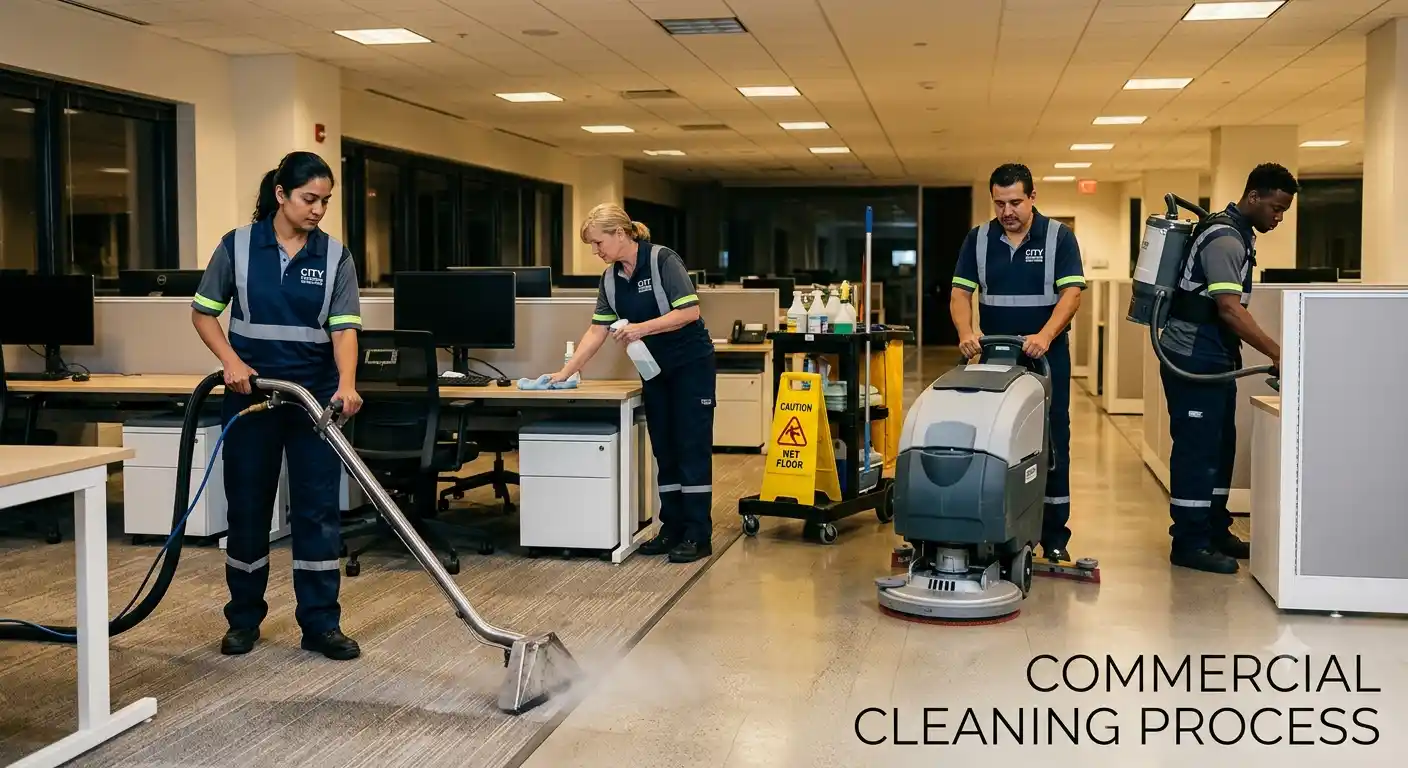
Once a contract moves past the trial period into regular service, the specific scope varies by facility type but typically covers:
- Washrooms and kitchens — usually the most frequent, reflecting hygiene priority and heavy use relative to size
- Desks and workstations — typically lighter-touch routine (surface cleaning and bin emptying), with deeper attention reserved for scheduled deep cleans
- Floors throughout the building
- Shared spaces — reception areas, meeting rooms, and corridors
The exact combination and frequency depends entirely on what was agreed during the initial site visit. Scheduled deep cleans sit outside the standard daily or weekly routine and should be specified separately within the contract scope, for example through our Edinburgh deep cleaning service for sites north of the border.
How is quality maintained after the contract starts
A properly run commercial cleaning contract does not simply start and then run on autopilot. Reputable providers check in with clients specifically after the first few visits, catching early issues before they become established patterns.
Ongoing quality assurance typically involves periodic supervisor visits to the site, a genuine feedback mechanism for flagging issues as they arise, and regular review conversations to confirm the original scope still matches the business's actual needs as they evolve. Businesses change, headcount grows, layouts shift, new areas are added, and a cleaning contract that is never revisited gradually drifts out of step with what a building genuinely needs.
What does a good escalation process look like
A clear escalation process is where many commercial cleaning relationships either hold together or quietly break down. Good escalation means knowing, in advance:
- Exactly who to contact if a specific clean falls short
- What response time to expect
- What remedy is offered — a follow-up visit, a credit against the next invoice, or a documented conversation about what went wrong and how it will be prevented going forward
Providers who handle this well tend to treat an occasional missed standard as a genuine opportunity to demonstrate reliability, responding quickly and transparently rather than becoming defensive. This responsiveness, more than any single clean being perfect, is usually the real marker of whether a commercial cleaning relationship will hold up well over the months and years that follow.
Does sector affect the commercial cleaning process
Yes, sector matters considerably more than most businesses realise. A scope written for a general office will not automatically suit a healthcare setting, a school, or a food service business.
| Sector | Key requirement |
|---|---|
| Healthcare and care environments | Documented infection control protocols and colour-coded equipment systems to prevent cross-contamination |
| Schools and educational settings | Enhanced DBS checks with children's barred-list check, plus cleaning scheduled entirely outside teaching hours |
| Food service and hospitality | Schedules and product choices aligned with environmental health inspection expectations |
A good provider raises these sector-specific considerations proactively during the initial scope conversation, rather than leaving a business to discover a compliance gap after it has already caused a problem.
What happens when the contract needs to change
Business needs rarely stay static for the life of a cleaning contract. A provider who treats scope adjustments as a normal part of the relationship, rather than an awkward renegotiation each time, is a significantly better long-term partner. Notice periods of one to three months are standard practice for most commercial contracts, and this should work both ways: if your provider can exit on a month's notice, you should have the same flexibility.
The clearest sign of a well-run commercial cleaning relationship is how smoothly genuine change gets handled. A business expanding into new premises, changing operating hours, or adding a higher-risk area, such as a server room or client-facing showroom, needs a provider able to adjust frequency, add areas, or revise consumables arrangements with minimal friction. Over a multi-year relationship, this adaptability is worth considerably more than a marginally lower headline price. You can browse our full range of cleaning services to see how we structure contracts as businesses grow.
Frequently asked questions
What is the difference between commercial and domestic cleaning?
Commercial cleaning involves structured schedules, specialist equipment, trained and often DBS-checked staff, and documented compliance standards such as COSHH. Domestic cleaning is typically a more informal arrangement, adjusted casually between a homeowner and an individual cleaner, without the regulatory accountability a business environment requires.
Why does a commercial cleaning provider insist on an in-person site visit?
A site visit allows scope to be agreed accurately room by room, since different areas, washrooms, reception, kitchens, carry different cleaning requirements. Quoting purely from a phone call or floor plan routinely misses details that only become clear when walking the actual site, which leads to either under-scoped contracts or inaccurate pricing.
Should I sign a long-term contract with a new commercial cleaning provider straight away?
Not necessarily. Many providers offer an initial trial arrangement, often around a month, before moving to a standard contract term, which allows both parties to properly assess fit and service quality before committing to a longer arrangement. It also creates low-stakes room to adjust the scope once real-world experience reveals gaps.
What credentials should a commercial cleaning company be able to provide?
Full insurance, typically £1 million minimum public liability cover with £5 million more common for larger contracts, DBS-checked staff, COSHH compliance documentation, and site-specific risk assessments. A reputable provider should produce all of these without hesitation, they reflect genuine legal and practical protections rather than optional paperwork.
How long does it take to get a commercial cleaning contract in place?
Timelines vary by provider and site complexity, but a professional process, enquiry, site visit, credential check, scope agreement, and trial commencement, typically takes one to three weeks. Providers quoting and starting significantly faster may be skipping steps worth taking seriously.
What should a commercial cleaning contract include?
At minimum: a clearly defined scope of work, agreed frequency and hours, consumables responsibilities, key holding and access arrangements, supervisor visit schedule, escalation contacts and procedures, notice period terms (typically one to three months, applying both ways), and trial arrangement details. Any contract that lacks these elements leaves meaningful ambiguity that tends to surface as a dispute later.