
How to hire a reliable commercial cleaner for your office
It's a question that catches many office managers off guard, usually after a bad experience with a supplier that looked promising on paper. A manager signs a six-month cleaning contract after reviewing a polished website and accepting a competitive quote. Within a fortnight, a different cleaner shows up each visit. By month two, visits are being skipped without notice, calls go unanswered for days, and the cleaning is mediocre at best. The manager is now spending hours chasing a supplier instead of doing their actual job.
Finding a reliable commercial cleaning partner is a process, not a transaction. The right company will have verified accreditations, insured and vetted staff, a proper contract, and a clear quality-monitoring process, the standard Tidy Spaces operates to across its commercial accounts in London, Manchester, Birmingham, Leeds, and Glasgow, and the benchmark this guide uses throughout.
What Actually Signals a Reliable Provider
- Accreditations: BICSc training, SafeContractor or CHAS, and ISO 9001 are the strongest verifiable signals, and a credible company will produce them unprompted.
- Insurance: employers' liability insurance is a legal requirement for any company with staff, minimum £5 million cover, and public liability of £1 million to £5 million should be standard practice.
- Pricing: expect £15 to £40 an hour depending on region, or a monthly retainer from around £400 for a small office up to £5,000 or more for larger multi-floor sites.
- Contract: a written SLA with measurable response times, a fair exit clause, and a notice period you can actually live with matters more than the headline price.
What makes a commercial cleaning company genuinely reliable
Reliability in office cleaning has little to do with price and even less to do with how professional a website looks. It's built on consistent staffing, clearly defined accountability, and formal operational processes that function whether or not the sales rep is watching. The good news is that these things are verifiable, if you know what to look for.
Accreditations and professional memberships worth checking
BICSc (British Institute of Cleaning Science) is the strongest professional signal in this sector. Staff who hold BICSc training have been assessed against a structured curriculum covering chemical handling, colour-coding systems, equipment use, and cross-contamination control, a competency-based qualification, not merely a course attendance certificate.
Beyond BICSc, look for SafeContractor or CHAS accreditation, both Safety Schemes in Procurement (SSIP) members that confirm the company has passed an independent health and safety assessment; many larger clients won't appoint a contractor without one. ISO 9001 indicates a documented quality management system is in place. ISO 14001 shows the company manages its environmental impact formally, and ISO 45001 covers occupational health and safety at a system level. A company tendering for a serious commercial account should be able to produce at least two or three of these without being asked twice.
Vetted employees versus unvetted subcontractors
There's a meaningful difference between a company that directly employs and manages its cleaning staff and one that subcontracts informally. Direct employment generally means DBS-checked operatives, consistent oversight, and clear accountability when something goes wrong. If you ask a contractor who will be on your site each morning and they can't give you a specific answer, that is your answer.
Why backup cover matters as much as credentials
A company can hold every accreditation above and still let you down if one cleaner calls in sick and the visit is silently skipped. Ask specifically how absences are handled. Do they maintain a trained reserve pool? Is there a supervisor who can step in at short notice? This single question separates a professional operation from a one-person band with a smart-looking website.
Vetting questions that reveal whether a cleaner is consistent
Most suppliers will say the right things in a sales conversation. The right questions force specifics, and the quality of those specifics tells you far more than any brochure could.
Questions about staffing and day-to-day continuity
Ask who will actually clean your office, whether they are direct employees or subcontractors, and how long the current crew has been on similar accounts. Ask what the company's staff turnover rate looks like, high turnover is a consistent predictor of inconsistent service. Then ask who your named point of contact will be and what their response-time commitment is for both urgent and routine queries.
How they handle quality control and missed tasks
Find out whether the company uses written checklists, scheduled supervisor inspections, or digital monitoring tools. Ask to see a sample inspection report from a current account. If a task is missed, what is the formal complaint process and what is the correction response time? A company that handles complaints well is more valuable than one claiming it never has any.
Getting references that actually tell you something
Request two or three current client references from offices of comparable size and sector. When you call, ask how long the contract has run, whether the same crew attends consistently, how quickly issues get resolved, and whether they'd re-sign. A client who has stayed with the same cleaning company for three or more years and still recommends it is the strongest independent signal available.
Insurance and compliance checks you cannot afford to skip
Insurance isn't a formality, it's the mechanism that protects your business if a cleaner damages property, causes injury, or has an accident on your premises. A verbal "yes, we're covered" is not sufficient documentation.
Public liability insurance isn't a legal requirement for cleaners, but any credible commercial cleaning company will hold it as standard, and you should require it as a contract condition; cover typically ranges from £1 million to £5 million, with higher-footfall offices pushing towards the upper end. Employers' liability insurance, by contrast, is a legal requirement under the Employers' Liability (Compulsory Insurance) Act 1969 for any cleaning company that employs staff, with a statutory minimum of £5 million, and fines of up to £2,500 for every day a company operates without it. Ask to see current certificates, not verbal confirmation.
For offices handling sensitive documents, client data, or restricted areas, DBS-checked staff are essential. A Basic DBS check is typical for standard commercial office cleaning; a Standard DBS may be appropriate where cleaners have unsupervised access to particularly sensitive areas. COSHH compliance (Control of Substances Hazardous to Health) is a legal obligation covering how cleaning chemicals are stored, labelled, and handled on-site, and a professional provider will produce method statements and COSHH data sheets before you have to ask.
Build a simple document checklist before engaging any supplier: current public liability certificate, employers' liability certificate, DBS vetting policy, COSHH method statement, and relevant accreditations. A reputable contractor will have these ready without hesitation. If a company stalls, produces out-of-date documents, or claims they're "in the post," treat that as a red flag and move on.
How to read and compare quotes in the UK cleaning market
Price comparison is straightforward when all quotes cover the same scope. In practice, they rarely do, which is why the cheapest quote frequently isn't what it appears to be.
| Pricing model | Typical range | Best for |
|---|---|---|
| Hourly rate per operative | £15–£30 UK-wide, up to £40 in London | Ad hoc or low-frequency cleaning |
| Fixed monthly retainer | £400–£800 (small), £800–£2,000 (medium), £5,000+ (large multi-floor) | Ongoing scheduled contracts, most offices |
| Per-square-metre | £1.50–£4.00 per m² per clean | Large or variable-footprint sites |
The monthly retainer model suits most office managers because it creates predictable costs on both sides. See our commercial cleaning overview for how this is typically scoped and delivered.
Before sending any request for quotation, write a clear specification: which rooms, what tasks, what frequency, and whether consumables are included. Send that same document to every supplier and ask them to quote against it. If one quote arrives significantly below the others, the most likely explanation is that something has been excluded rather than that the company is more efficient, get at least three quotes and scrutinise the outliers carefully.
If a quote comes in well below market rate, ask directly how they're achieving it. Common explanations include lower-paid agency staff with no DBS checks, cutting visit frequency below what was specified, or removing supervisory oversight from the scope entirely. A cleaning company that cannot sustain its quoted rate without cutting corners will cost you considerably more before the contract is halfway through.
Contract terms and SLA essentials that protect your office
A verbal agreement and a one-page summary are not a contract. For an ongoing arrangement, the right document protects you if service deteriorates, staff change, or you need to exit without notice.
| SLA element | What good looks like |
|---|---|
| Response time (urgent issue) | Commonly within two working hours |
| Rectification time | Commonly within eight working hours once confirmed |
| Quality audits | Named auditor, set frequency, written reports |
| KPIs tracked | Audit pass score per zone, missed-task rate, re-clean response time |
Ask whether the supplier uses a digital platform or inspection sheet to record these, and whether you'll receive regular performance summaries. Measurable standards make it far easier to have a constructive conversation if service slips, rather than relying on subjective impressions.
A fair UK office cleaning contract typically includes a notice period of four to eight weeks, a formal process for raising and escalating complaints, and a regular review date, often quarterly or annually. Initial terms commonly run for twelve months, frequently with a shorter trial arrangement at the start; our full breakdown of what happens from enquiry to ongoing contract covers how that trial period and notice terms typically work in practice. Avoid contracts requiring six months' notice to exit with no performance-based break clause, your negotiating leverage disappears the moment you sign something with no way out.
Red flags that should end the conversation immediately
Most unreliable cleaning companies don't announce themselves. They rely on vague promises, professional-looking branding, and the fact that most clients don't ask the hard questions.
Operational warning signs during the vetting process:
- No clear answer on who will be on-site each visit
- Inability to produce insurance certificates or accreditations on request
- References that are vague, unverifiable, or give non-specific answers
- A quote sent within hours with no site visit or specification review
Contract and commercial red flags:
- No exit clause, or a disproportionately long notice period
- Vague SLA language around response and rectification times
- Costs appearing in the contract that weren't mentioned in the initial quote
- No reference to DBS vetting or insurance anywhere in the paperwork
A legitimate outsourced cleaning contractor, whether you're sourcing contract cleaners for offices or broader janitorial services, has nothing to hide in its paperwork. If a supplier resists putting agreed terms in writing, that resistance is the answer to your question.
Your 7-step procurement checklist for finding a reliable commercial cleaner
Use this framework every time you appoint a commercial cleaner, whether you're starting fresh or replacing a supplier that has let you down.
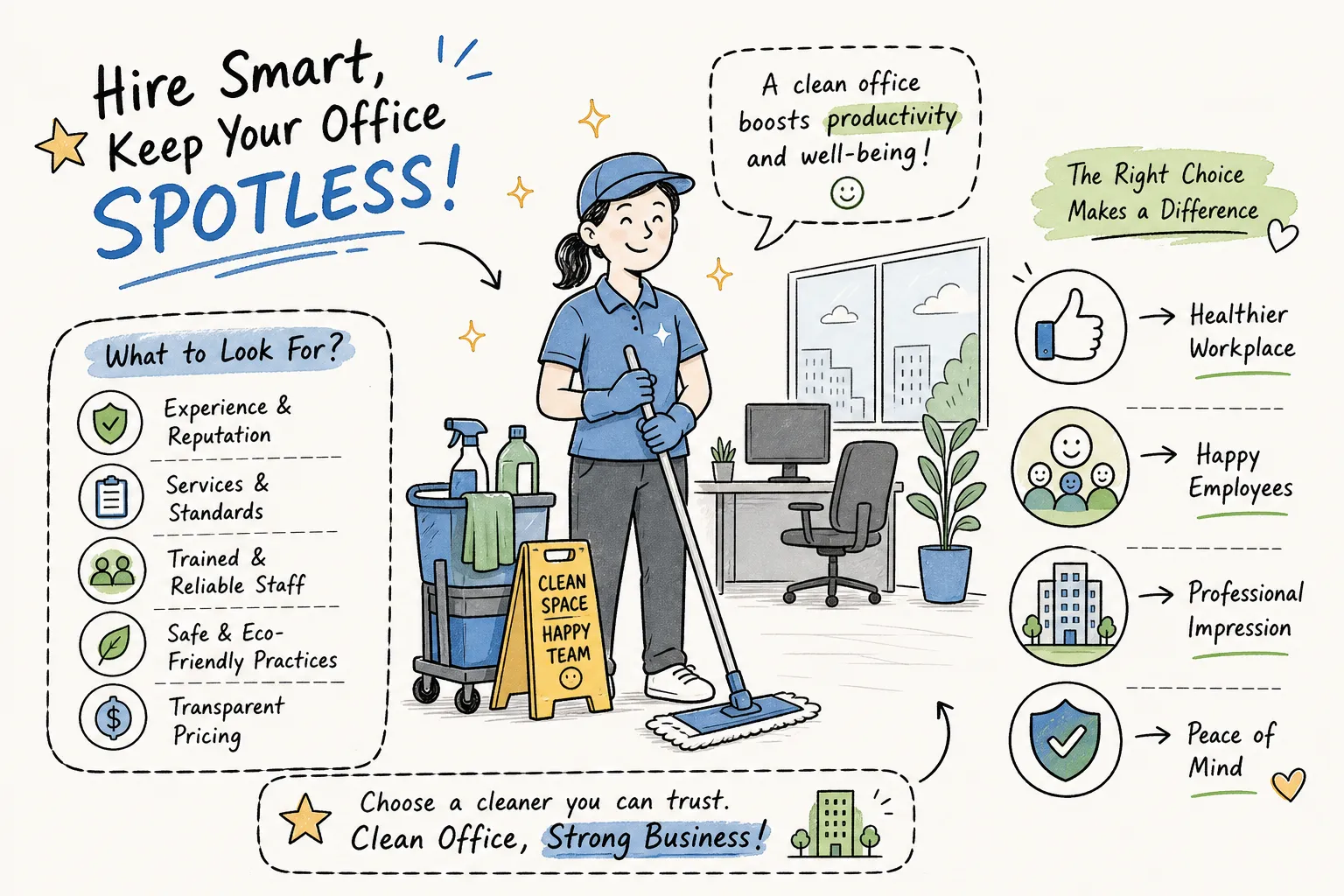
- Shortlist companies with verified accreditations: BICSc training, SafeContractor or CHAS, and ISO 9001 as a minimum baseline.
- Confirm the staffing model: direct employees with DBS checks, not informally contracted operatives with no oversight.
- Run the vetting questions on staffing continuity, backup cover, quality-control process, and complaint handling.
- Request the compliance documents: public liability certificate, employers' liability certificate, COSHH method statement, and DBS vetting policy.
- Issue a written specification and ask every supplier to quote against the same document so comparisons are genuinely like-for-like.
- Review the contract SLA: scope, schedule, response times, rectification policy, measurable KPIs, and exit clause.
- Call the references before signing, asking specifically about staffing consistency, turnover on the account, and how complaints were handled.
Build the relationship on proof, not promises
So, how do you find a reliable commercial cleaner for your office? Look for companies that can demonstrate their reliability before you sign anything. The suppliers that deliver consistently are the ones that produce accreditations unprompted, hand over insurance certificates without being chased, give you concrete references with real tenure, and put a proper SLA in writing before you've had to ask twice.
Every element of the vetting process in this guide is designed to surface that evidence quickly, so you spend less time managing your cleaner and more time running your office. Tidy Spaces provides fully vetted, insured commercial cleaning across London, Manchester, our Birmingham commercial contract team, Leeds, and Glasgow, with transparent pricing, consistent staffing, and a written satisfaction guarantee. Get in touch for a no-obligation quote if you want to see what a properly structured commercial cleaning arrangement looks like in practice.
Frequently asked questions
How do I find a reliable commercial cleaner for my office?
Start by shortlisting companies with verified accreditations such as BICSc, SafeContractor, or CHAS. Ask structured vetting questions about staffing continuity and backup cover, request compliance documents including current insurance certificates, and always call references before signing. Issue a written specification so every quote covers the same scope, then review the SLA carefully for measurable KPIs and a fair exit clause.
What insurance should a commercial cleaning company hold?
At minimum, require public liability insurance (£1 million to £5 million cover) and employers' liability insurance, a legal requirement with a statutory minimum of £5 million for any company with staff. Ask to see current certificates, not verbal assurances, before any contract is signed.
How much does office cleaning cost in the UK?
Hourly rates typically range from £15 to £30 per operative UK-wide, rising to around £40 in London. Monthly retainers for small offices generally run from £400 to £800, rising to £800–£2,000 for medium-sized premises and £5,000 or more for larger, multi-floor sites. Always compare quotes against an identical written specification to ensure the figures are truly like-for-like.
What is the difference between contract cleaners and janitorial services for offices?
Contract cleaners typically provide scheduled cleaning on a fixed-term agreement, daily, weekly, or otherwise, whereas janitorial services for offices may also include ongoing on-site support such as restocking consumables, minor maintenance checks, and reactive cleaning throughout the day. The right model depends on your office size, footfall, and budget.