
Deep cleaning wooden floors: safe methods that won't damage them
The best methods for deep cleaning wood floors use a barely damp microfibre mop, a pH-neutral cleaner formulated specifically for wood, and immediate drying after each section, nothing more. Vinegar, steam cleaners, and soaking mops are among the most commonly recommended approaches, and all three cause genuine damage over time.
Understanding why common advice goes wrong, and what actually protects a wood floor's finish, is the difference between a safe deep clean and one that gradually causes irreversible harm.
What the Evidence Shows
- Vinegar, ammonia, and steam all chemically or physically degrade a wood floor's protective finish over repeated use, despite being widely recommended as gentle or natural options.
- The correct approach uses a barely damp microfibre mop with a pH-neutral cleaner specifically formulated for wood floors, never a wet or soaking mop.
- Different finishes, oiled, lacquered, solid wood, respond differently to moisture and products, so identifying your floor's finish before cleaning genuinely matters.
- Immediate drying after each mopped section, rather than air drying, prevents the water damage and streaking that ruins so many otherwise careful deep cleans.
Myth #1: Vinegar is a safe, natural way to clean wood floors
Common assumption: vinegar is natural, mild, and effective on many household surfaces, so it should be fine on wood floors too.
Why it sounds logical: vinegar genuinely works well on tile, glass, and sealed stone. It's non-toxic and inexpensive, which reinforces the assumption that it's a responsible, gentle choice.
Why it's actually harmful: vinegar's mild acidity actively breaks down the finish that protects wood flooring, whether that's a lacquer, oil, or wax coating. The damage doesn't happen catastrophically after a single clean. Instead, it accumulates slowly: the finish dulls, its protective capacity weakens, and the wood beneath becomes increasingly exposed to moisture and everyday wear. By the time the damage is visually obvious, it is often irreversible without professional refinishing.
The correct approach: a pH-neutral cleaner specifically formulated for wood floors is the safe alternative. These products clean effectively without any chemical interaction with the finish itself.
Myth #2: Steam cleaning gives a deeper, more thorough clean
Common assumption: steam cleaners provide a chemical-free, deep clean that's more thorough than a standard damp mop.
Why it sounds logical: steam cleaners have a well-earned reputation on tile, sealed stone, and various other hard surfaces. The combination of heat and pressure genuinely does produce an intensive clean on those materials.
Why it's actually harmful: on wood flooring specifically, that same intensity works against you. Steam forces both moisture and heat directly into the wood's surface and into the seams between boards. It is precisely this combination, heat plus dampness, that causes warping, cupping, and finish degradation over time.
The correct approach: a barely damp microfibre mop is always preferable to a steam cleaner on genuine wood flooring. For stubborn areas, a careful second pass with fresh solution is a far safer escalation than introducing steam or heat.
Myth #3: Any product labelled "wood floor cleaner" will work
Common assumption: if a product is marketed as a wood floor cleaner, it is suited to all wood floor types.
Why it's actually harmful: not every product labelled as a wood floor cleaner is formulated for every type of finish. Using a product designed for lacquered floors on an oiled floor, or vice versa, can leave residue, dull the surface, or fail to provide what the floor actually needs.
The correct approach: check that your specific cleaning product is explicitly suited to your floor's actual finish type. When in doubt, test any new product on a small, inconspicuous area, inside a wardrobe, or under a rug's usual position, before applying it across the whole floor.
Understanding your floor's finish before you clean
Before any deep clean, identify exactly what type of finish your floor has. Oiled floors, lacquered surfaces, and solid wood flooring all respond quite differently to moisture and cleaning products.
| Finish type | How it responds to cleaning | What it needs |
|---|---|---|
| Lacquered | Sealed surface, more resistant to moisture | Basic pH-neutral wood floor cleaner |
| Oiled | Open-pore finish, absorbs products readily; plain water can gradually lift the oil over time | Specialist replenishing cleaner formulated for oiled floors |
If you are unsure what finish your floor has, check any documentation from installation or refinishing, or contact whoever fitted the floor. This single step prevents the most common mistake in wood floor cleaning: applying an approach that is mismatched to your specific surface.
The correct method: step-by-step
It's worth noting that the strictest guidance from some flooring bodies recommends dry cleaning only, avoiding any dampness on a wood floor at all. The barely-damp method below is the accepted middle ground used by most manufacturers and retailers, and is a safe, effective approach for most finishes when followed carefully.
- Preparation: remove all furniture and rugs from the area, then vacuum thoroughly, paying particular attention to corners and edges where dust and grit accumulate most heavily. Abrasive debris left on the floor can scratch the finish once you begin mopping.
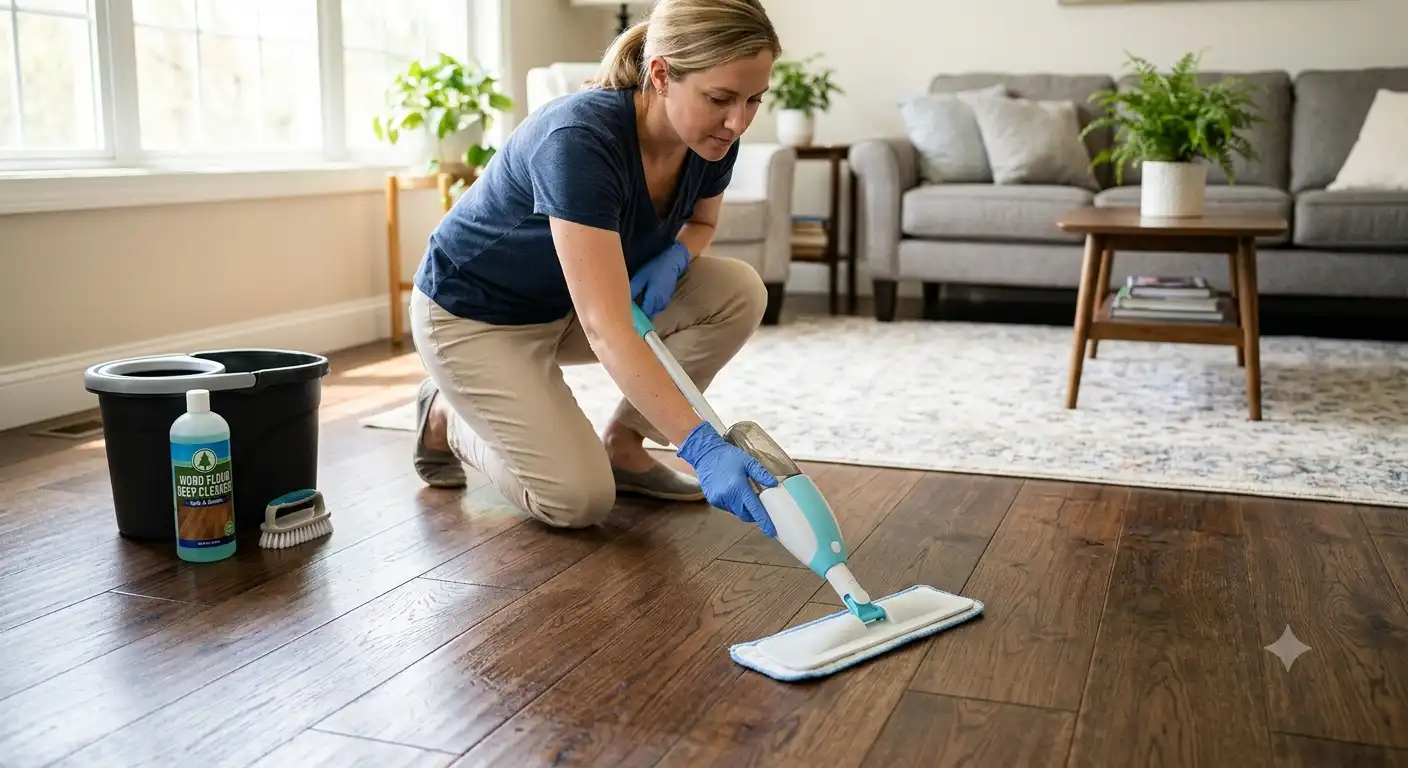
- Correct tools: use a microfibre mop that is only damp, genuinely never wet, combined with a pH-neutral cleaner specifically formulated for wood flooring. Avoid general household cleaners and anything acidic.
- Proper technique: wring out the mop thoroughly before it touches the floor, and always work with the wood grain rather than across it. This helps avoid pushing moisture into the seams between boards, where it can cause lasting damage.
- Immediate drying: as you finish mopping each section, immediately go over the damp area with a dry mop or microfibre cloth to absorb any remaining liquid. Do not leave the floor to air dry naturally.
Why immediate drying matters so much
It is worth dwelling on this point specifically, since it is the step most commonly skipped when time is short. Professional and manufacturer guidance consistently emphasises section-by-section cleaning for exactly this reason: mopping an entire room and then beginning the drying process creates a window during which water has time to penetrate wherever the finish allows it to.
What actually causes the damage is not the act of mopping itself, but the standing time between application and drying. Reducing that window to near zero, by drying each section the moment it has been mopped, is the single most effective thing you can do to protect a wood floor during deep cleaning.
What a genuine deep clean addresses beyond routine mopping
A proper deep clean goes further than the mopping process described above. This includes attention to skirting boards and edges where dust and grime accumulate over time, spot treatment of visible scuff marks using an appropriate wood-safe product, and a considered assessment of the floor's overall condition.
For floors showing significant wear, particularly in high-traffic areas like hallways or in front of frequently used doorways, it is worth assessing whether the floor might benefit from a proper refresh coat or professional refinishing. Cleaning maintains a floor's condition, it cannot reverse finish wear that has already progressed beyond what surface cleaning can address. If you'd like a wider assessment of your home's floors alongside a deep clean, our deep cleaning service covers this as standard.
Building a maintenance routine that avoids a rescue job
The best long-term approach combines light, frequent maintenance with periodic proper deep cleans, rather than leaving floors to accumulate grime for extended periods and then attempting to restore them in a single session. Regular dry dust-mopping or vacuuming between deep cleans prevents grit from accumulating to the point where it causes scratching.
Wiping up spills immediately, rather than leaving liquid to sit even briefly, prevents the localised water damage that often causes the dark staining or warping that homeowners later mistake for general ageing. None of this needs to be time-consuming day to day. If you're new to what a proper deep clean actually covers beyond routine mopping, our guide to what deep cleaning really means explains where the line sits.
When professional help becomes the right step
If genuine grime persists even after a careful second pass with fresh solution and a clean microfibre cloth, this is the point at which professional assessment becomes worthwhile, rather than escalating to increasingly aggressive products or methods that risk causing the exact damage this whole approach is designed to avoid.
A professional can assess whether the issue is surface grime or whether the floor's finish has worn through in a specific area and requires proper refinishing rather than more intensive cleaning. If you're in the area, our Harrow deep cleaning team can take a look at floors alongside the rest of a property.
Frequently asked questions
What are the best methods for deep cleaning wood floors without damaging them?
The best methods for deep cleaning wood floors use a barely damp microfibre mop, a pH-neutral cleaner formulated specifically for your floor's finish type, and immediate drying after each section. Avoiding vinegar, steam cleaners, and excessive water is equally important, these are among the most common causes of finish damage.
How often should wood floors be deep cleaned?
The frequency depends on foot traffic and how consistently light maintenance is performed between cleans. In most homes, a proper deep clean every one to three months, combined with regular dry dust-mopping or vacuuming, is sufficient to maintain the floor's condition without over-cleaning.
Can I use a mop with a built-in spray function on wood floors?
Spray mops can be used on wood floors provided the spray function delivers a very fine mist rather than a heavy application of liquid, and provided the cleaning solution used is pH-neutral and formulated for wood. The "barely damp, never wet" principle applies regardless of the mop type. Always dry each section immediately after mopping.
What is the difference between an oiled wood floor and a lacquered one, and does it change how I clean them?
Yes, it changes both the products and the approach. Oiled floors have an open-pore finish that absorbs cleaning products more readily and often requires periodic maintenance oil alongside cleaning, and cleaning with plain water can gradually lift the oil finish over time. Lacquered floors have a sealed surface that sits on top of the wood and generally only need a basic wood floor cleaner. Always match your cleaning product to your specific finish type.
At what point does a wood floor need refinishing rather than cleaning?
When the finish in high-traffic areas appears visibly worn, dull, or unresponsive to cleaning, or when dark staining or localised warping is present, these are signs that the finish itself has degraded beyond what cleaning can address. In these cases, professional refinishing restores what surface cleaning cannot.