

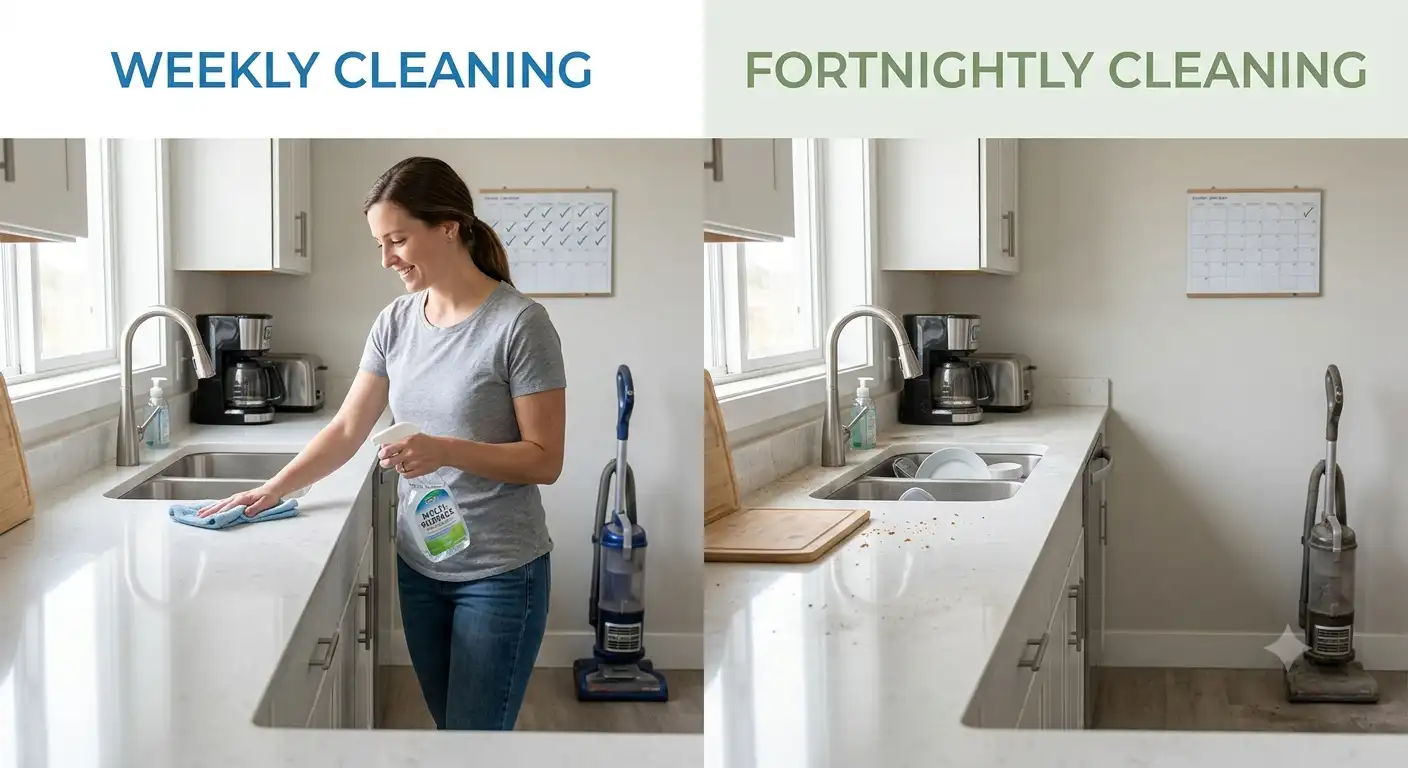
Weekly vs fortnightly cleaning: which schedule actually suits your home?
The honest answer is that it depends on three things: how quickly your home actually gets dirty, what you're willing to spend each month, and how much upkeep you're prepared to do yourself between visits. Neither schedule is objectively better — a weekly clean suits busy, high-traffic households that want consistent standards, while a fortnightly clean suits smaller or quieter homes that stay reasonably tidy on their own. This guide breaks down the real cost difference, which households genuinely benefit from each option, and how to decide without guessing.
The Frequency Trade-Off
- Weekly cleaning typically costs £1–£2 less per hour than fortnightly, because regular bookings are more efficient for cleaners to schedule and often qualify for loyalty discounts.
- Across the UK, standard domestic cleaning runs roughly £14–£30 an hour depending on region and whether you book independently or through an agency, with weekly slots usually sitting toward the lower end of that range.
- A fortnightly visit typically needs two to three hours to cover a standard home properly, compared with one to two hours for a weekly top-up.
- Households with pets, young children, or multiple occupants tend to see the biggest gap in results between weekly and fortnightly — everyone else has more room to choose based on budget alone.
Why cleaning frequency affects the price you pay
It seems counterintuitive at first — booking a cleaner less often should cost less overall, and it does in total monthly spend, but the hourly rate itself is usually a little higher for fortnightly visits.
Regular weekly bookings are easier for cleaning companies to plan around. The same cleaner can often be assigned to the same round every week, reducing travel time and admin, and many companies pass some of that efficiency saving on as a lower rate or a loyalty discount. Fortnightly and one-off bookings are harder to slot efficiently into a schedule, so the hourly rate tends to sit slightly higher to reflect that. For a full breakdown of what drives UK cleaning rates more broadly, our full UK hourly rate breakdown covers the regional and independent-versus-agency factors in more depth.
There's also a practical reason the gap tends to widen slightly in London and the South East. Cleaners in these areas have more choice over which bookings they take on, so the scheduling premium for less predictable fortnightly work is usually a little more pronounced than it is elsewhere in the UK, where booking density is lower and cleaners have less room to be selective about frequency.
Weekly vs fortnightly cleaning cost compared
Weekly cleaning in the UK typically costs £16–£22 per hour outside London and £20–£26 in London, while fortnightly cleaning usually runs £18–£24 outside London and £22–£28 in London — roughly £1–£2 more per hour, reflecting the harder-to-schedule nature of less frequent visits. These figures sit within the same £14–£30 national range that applies across UK domestic cleaning generally.
| Schedule | Rest of UK (per hour) | London (per hour) |
|---|---|---|
| Weekly clean | £16–£22 | £20–£26 |
| Fortnightly clean | £18–£24 | £22–£28 |
| Independent cleaner (either schedule) | £14–£18 | £16–£22 |
| Agency cleaner (either schedule) | £18–£24 | £22–£30 |
The independent-versus-agency gap applies on top of the frequency difference, so an independent cleaner booked weekly is usually the most affordable combination, while an agency cleaner booked fortnightly tends to sit at the higher end. Because a fortnightly visit also runs longer per session — typically two to three hours against one to two for a weekly top-up — the higher hourly rate is partly offset by fewer total hours booked across the month.
What weekly cleaning gets you
- Dirt, dust, and clutter never get the chance to build up, so each visit stays quick and manageable rather than turning into a bigger job
- Meaningfully lower dust and allergen levels, which matters if anyone in the household has asthma or allergies
- Very little upkeep required from you between visits, since the gap is short enough that things rarely get out of hand
- A consistently presentable home, which suits households that entertain regularly or simply prefer not to think about cleaning day-to-day
What fortnightly cleaning gets you
- A genuinely lower monthly bill, since you're paying for half the visits despite the slightly higher hourly rate
- Enough coverage for smaller households, couples, or single occupants where mess simply doesn't accumulate as fast
- Fewer scheduled appointments to work around, which some households prefer for privacy or flexibility reasons
- A workable option provided you're willing to handle light upkeep — wiping surfaces, a quick hoover, keeping the bathroom presentable — during the off week
Where the choice genuinely isn't close
For most households, either schedule works reasonably well and the decision comes down to budget and preference. But a few scenarios tend to make one option clearly better than the other.
Homes with pets, young children, or more than three occupants usually see a visible difference in how the space looks and feels between a weekly and fortnightly schedule — fur, spills, and general wear accumulate fast enough that a two-week gap starts to show. On the other hand, a single occupant or couple who works long hours and keeps a relatively tidy home day-to-day often finds fortnightly perfectly sufficient, with no real benefit from the extra weekly cost.
Switching between weekly and fortnightly
Most cleaning companies, including ours, let you change frequency without any penalty — it simply means adjusting the recurring booking going forward. It's worth reviewing after the first month or two on either schedule: if a fortnightly clean consistently leaves rooms looking tired well before the next visit, that's a clear signal to move to weekly, and vice versa if a weekly clean feels like overkill.
Hybrid and seasonal schedules
You don't have to pick one schedule and stick with it year-round. Some households go weekly through winter, when muddy floors and more time spent indoors increase cleaning demand, then drop to fortnightly over summer when everyone's out more and the house naturally stays tidier. Others book weekly during busy periods — after a house move, during illness recovery, or with visitors staying — then scale back once things settle. A good cleaning provider should be able to flex the schedule with you rather than locking you into a single fixed frequency.
It's also worth pairing a regular fortnightly schedule with an occasional one-off deep clean rather than switching to weekly permanently. A fortnightly clean keeps the day-to-day basics under control, while a deep clean every few months handles the buildup that a regular visit isn't scoped to cover — inside appliances, grout, skirting boards, and other areas that need more time than a standard visit allows. This combination often works out cheaper than moving to weekly year-round, while still keeping the home from ever feeling genuinely behind.
What a standard visit covers, whichever schedule you choose
- Kitchen surfaces, hob, sink, and floors
- Bathroom sanitising, including toilet, shower or bath, and sink
- Dusting throughout, including skirting boards and reachable surfaces
- Vacuuming and mopping all hard and soft flooring
- Bed making and general tidying, where agreed in advance
Trying a schedule before committing
If you're genuinely unsure which frequency fits your household, it's worth trialling one for four to six weeks before committing to a longer-term arrangement. That's usually enough time to see whether the gap between visits feels comfortable or whether the house is visibly slipping before the next clean arrives. Most providers, including ours, are happy to adjust frequency after a trial period without any hassle.
How to decide between weekly and fortnightly
- Be honest about how quickly your home actually gets messy — household size, pets, and how much time everyone spends at home all matter more than personal preference alone.
- Set a realistic monthly cleaning budget first, then work out which frequency and provider type fits within it.
- Decide how much upkeep you're genuinely willing to do yourself between visits — fortnightly only works well if you'll keep on top of the basics in the off week.
If you're still not sure after weighing those three factors, starting with a trial period on either schedule and adjusting from there is a perfectly reasonable way to decide. You can get a personalised cleaning quote for either frequency, or explore the rest of what we do if you're also considering a one-off deep clean alongside your regular schedule.
Frequently asked questions
Is weekly cleaning always cheaper per hour than fortnightly?
Generally yes. Weekly bookings are easier for cleaning companies to schedule efficiently, so the hourly rate is typically £1–£2 lower than fortnightly, with some providers offering an additional loyalty discount for regular weekly clients.
How many hours does a fortnightly clean typically take?
Most fortnightly visits take two to three hours for a standard UK home, compared with one to two hours for a weekly top-up clean. The exact time depends on property size and how much ground needs covering since the last visit.
Which is better for a household with pets or young children?
Weekly cleaning tends to suit these households better, since fur, spills, and general mess accumulate quickly enough that a two-week gap becomes noticeable. A fortnightly schedule can still work if you're prepared to handle extra upkeep yourself in the off week.
Can I switch from fortnightly to weekly cleaning later?
Yes. Most providers, including us, let you change your recurring booking frequency at any time without penalty. It's common to switch after a month or two once you have a better sense of how well a schedule is working.
Is a single occupant or couple better suited to fortnightly cleaning?
Often, yes. Homes with fewer occupants and less daily activity tend to stay reasonably tidy between visits, meaning a fortnightly clean is usually sufficient without a noticeable drop in standards.
Should I trial a schedule before committing long-term?
It's a sensible approach if you're unsure. Trialling either weekly or fortnightly for four to six weeks usually gives a clear enough picture of whether the gap between visits suits your household, and most providers will happily adjust frequency afterwards.