
What is an EHO actually scoring you against?
Deep cleaning restaurant kitchen compliance means maintaining a consistent, documented standard of hygiene across your entire premises — not just the surfaces an inspector can see. Done properly, it directly influences your Food Hygiene Rating, your insurance cover, and your long-term commercial reputation.
Nobody schedules an EHO visit into their diary. Environmental Health Officers turn up unannounced, walk your kitchen with a clipboard and a genuinely trained eye, and within an hour have formed a view of your business that gets published online for every prospective customer to see. Given how much rides on that single visit, it's worth treating deep cleaning readiness as an ongoing operational state — not a scramble the week you suspect an inspector might be due.
The Stakes, in Numbers
- EHOs score three areas: food handling hygiene, the physical condition and cleanliness of the premises, and confidence in your management systems and record-keeping.
- Up to 70% of commercial kitchen fires are linked to grease build-up in extraction systems — which is why TR19 extraction cleaning matters as much as visible surface hygiene.
- Ratings run from 0 to 5 in England, Wales and Northern Ireland, and that number sits publicly online, directly shaping whether customers walk through your door.
- A missing deep-clean certificate can void an insurance claim after a kitchen fire, independent of whether the fire was actually caused by extraction grease.
An EHO assesses three distinct areas: food handling practices, the physical condition of the premises, and confidence in your management systems. A poor score in any one area can drag down an otherwise strong inspection.
It helps to understand this structure before worrying about specific cleaning tasks, because the rating you end up with isn't a single pass-or-fail judgement on cleanliness alone. Inspectors assess:
- How hygienically food is handled, prepared, cooked, and stored
- The physical condition and structure of the premises — including cleanliness, layout, lighting, ventilation, and pest control
- Their confidence in your management systems — whether you can demonstrate, through records and staff knowledge, that food safety is being managed consistently
This third category catches a lot of businesses out. A kitchen can look spotless on inspection day and still score poorly if the inspector can't find evidence of a consistent cleaning schedule, or if staff can't explain the reasoning behind basic food safety practices when asked directly. Deep cleaning restaurant kitchen compliance, properly understood, means all three areas working together — not just a kitchen that happens to be gleaming on the morning the inspector arrives. It's a similar principle to what underpins a thorough, top-to-bottom deep clean in any high-stakes environment — consistency matters more than a single good day.
How does the Food Hygiene Rating Scheme work?
In England, Wales and Northern Ireland, the Food Hygiene Rating Scheme scores premises from 0 (urgent improvement required) to 5 (very good). This score is published publicly and is searchable online.
Each of the three assessment areas is scored individually, then added together. Food handling and premises condition are each scored 0, 5, 10, 15, 20 or 25; management confidence is scored 0, 5, 10, 20 or 30. The combined total determines the published 0–5 rating — the higher the point total, the lower the star rating, so a genuinely clean, well-documented kitchen with confident staff is what keeps the score down.
The commercial stakes of a poor rating go well beyond immediate embarrassment. A low score genuinely affects footfall, and for businesses that rely on delivery platforms or online reviews, a visibly poor hygiene rating sitting alongside your listing is a direct, ongoing cost — not a one-off inconvenience that fades once the inspector leaves.
It's also worth noting that a rating isn't fixed once given. Businesses can request a re-inspection after making genuine improvements, though this typically comes at a cost and isn't guaranteed to happen quickly. That is precisely why avoiding a poor score in the first place is far more valuable than trying to recover from one afterwards.
What do inspectors check in the physical kitchen?
Inspectors examine the full physical condition of your kitchen, including equipment, layout, ventilation, pest evidence, and back-of-house areas. Documented cleaning schedules covering every area are essential.
Beyond food handling itself, inspectors look closely at the structural condition of the premises — and this is where deep cleaning specifically, rather than day-to-day tidying, becomes relevant. They check for:
- Documented cleaning schedules covering every area and piece of equipment
- Back-of-house areas, including staff changing rooms and toilets (these are assessed as part of the premises, not treated as an afterthought)
- Layout, lighting, and ventilation standards
- Any evidence of pest activity
A kitchen with poor ventilation isn't just uncomfortable to work in — it also creates exactly the conditions where grease and moisture accumulate faster than routine cleaning can keep pace with. This loops directly back into extraction system hygiene, covered below.
Why does extraction system cleaning (TR19) matter for compliance?
TR19 is the recognised UK standard for cleaning kitchen extraction systems. Grease build-up in these systems is linked to up to 70% of commercial kitchen fires, making TR19 cleaning a legal, insurance, and safety requirement — not an optional extra.
This is the part of restaurant kitchen deep cleaning compliance that is easiest to overlook, precisely because it is largely out of sight. Grease accumulates inside canopies, filters, extractor fans, and the ductwork running through the building — areas a surface-level clean, however thorough visually, simply does not reach.
TR19, developed by BESA, sets a documented and verifiable standard for degreasing all of these components, with recommended minimum cleaning frequencies based on how hard the kitchen is worked:
| Usage level | Cooking hours per day | Cleaning frequency |
|---|---|---|
| Heavy use | 12–16 hours | Every 3 months |
| Moderate use | 6–12 hours | Every 6 months |
| Light use | 2–6 hours | Every 12 months |
More frequent cleaning may be required depending on the type of cooking, the condition of the system, and the results of any insurance or fire risk assessment. There is a financial dimension here too, separate from fire risk. Most commercial insurance policies require regular, documented professional extraction cleaning as a condition of cover. Failing to produce a valid deep-cleaning certificate after a kitchen fire can void an insurance claim, regardless of what actually caused the fire in the first place.
It is worth keeping the TR19 certificate somewhere genuinely accessible — not just filed away and forgotten. If an EHO or an insurer's assessor asks to see proof of a recent clean, being able to produce it immediately, with a clear date and the areas covered, does more for your credibility in that moment than almost anything else you could show them.
What about grease traps and drainage?
Grease traps and drainage are a core part of commercial kitchen deep cleaning compliance. Neglecting them creates blocked drainage, standing water, and organic build-up — conditions that attract pests and directly affect EHO scoring.
Alongside extraction systems, grease traps sit in a similar category: essential, unglamorous, and easy to neglect precisely because they are not part of the visible kitchen. A proper commercial kitchen deep clean covers steam cleaning and sanitising of walls, ceiling tiles, light fixtures, sinks, and grease traps — treating these as integral parts of the process rather than separate concerns.
A kitchen that looks immaculate at counter height can still fail on pest evidence if what is happening below the surface has not had proper attention. Blocked or poorly functioning drainage leads directly to the conditions pests are drawn to, feeding into the pest control element of the structural assessment.
How do staff practices affect the EHO inspection?
Inspectors observe staff behaviour directly during a visit. Hand-washing practices, use of protective clothing, and compliance with food handling hygiene are all assessed — and good habits cannot be convincingly faked for a single inspection.
This is precisely why deep cleaning readiness needs to be a team-wide habit rather than a management-led exercise conducted the night before an anticipated visit. An inspector asking a member of staff directly about cleaning procedures, temperature control, or allergen handling — and receiving a confident, accurate answer — says considerably more about a well-run kitchen than the shine on the stainless steel that day.
What documentation do you need for EHO compliance?
Inspectors require documentary evidence of consistent food safety management: filled-in cleaning schedules, temperature logs, staff training records, and allergen procedures — typically maintained as part of a HACCP or Safer Food, Better Business system. Records must be up to date and readily accessible.
The management confidence element of the assessment comes down almost entirely to records. Inspectors want to see evidence rather than simply taking a manager's word that everything runs properly. Disinfectants used should carry BS EN 1276 certification, with Safety Data Sheets kept on site and contact times named directly on the cleaning schedule — a level of specificity that does more to demonstrate genuine control than a generic "kitchen cleaned daily" entry.
This documentation habit also creates a genuine internal early-warning system: a documented schedule with an obvious gap is far easier to spot and correct before it becomes a problem than relying on staff memory across a rotating team.
How should a restaurant build a deep cleaning schedule?
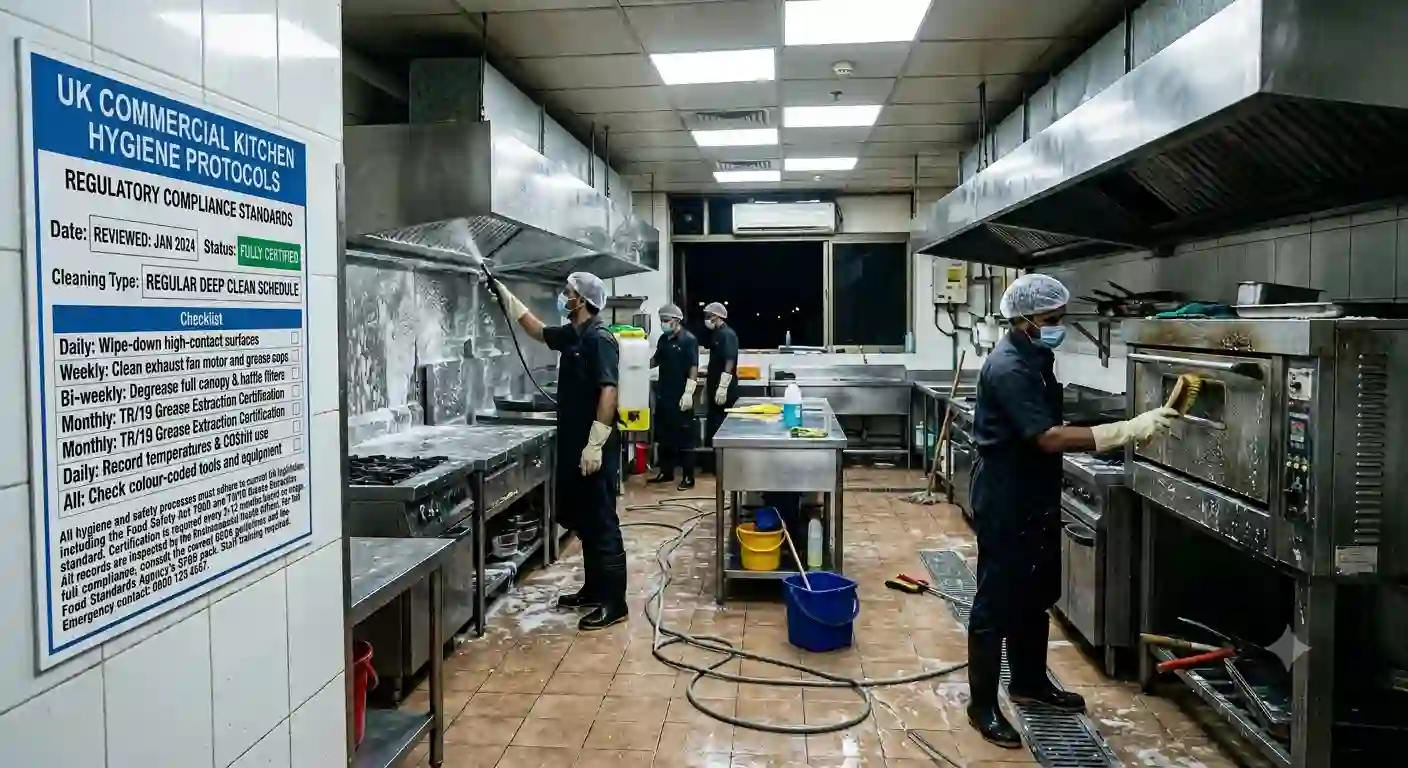
A compliant restaurant deep cleaning schedule operates on layered frequencies: daily surface cleaning, weekly or fortnightly attention to less visible areas, and periodic professional cleaning of extraction systems and grease traps.
A genuinely inspection-ready kitchen runs on this layered approach rather than one uniform routine:
- Daily: Surfaces, equipment used that day, and hygiene stations
- Weekly or fortnightly: Behind and under equipment, storage areas, staff facilities
- Periodic (professional): Extraction systems and grease traps, on a schedule matched to cooking volume — with TR19-certified cleaning at intervals set by insurance requirements and actual usage, not an arbitrary calendar date
Building this into a genuine, working schedule — rather than an aspirational document that exists mainly for inspection purposes — is what separates kitchens that pass comfortably from those that scrape by or fail unexpectedly. The businesses that consistently score well are not necessarily spending more on cleaning; they are simply treating it as a continuous operational discipline. For a sense of what professional periodic cleaning typically costs, our commercial cleaning pricing guide breaks down rates by property type and frequency.
It is worth appointing someone specifically to own this schedule day to day, rather than leaving it as a shared responsibility nobody fully owns. A named individual who checks that daily and weekly tasks are actually completed, chases up any gaps, and keeps professional extraction and grease trap bookings on track tends to produce far more consistent results than a rota that assumes everyone will simply remember their responsibilities. If you'd like help setting one up, speak to us about a kitchen compliance plan, or explore our full range of commercial cleaning services.
Frequently Asked Questions
How often should a commercial kitchen extraction system be professionally cleaned?
Frequency depends on cooking volume and type. Most insurance policies require regular TR19-certified cleaning — every 3 months for heavy-use kitchens (12–16 cooking hours a day), every 6 months for moderate use, and every 12 months for light use — because grease build-up is linked to the majority of commercial kitchen fires.
Does the EHO check areas outside the main kitchen?
Yes. Inspections cover back-of-house areas including staff changing rooms and toilets. The structural and cleanliness assessment applies to the whole premises, not just the main food preparation area.
Can a spotless-looking kitchen still receive a low hygiene rating?
Yes. If documentation and management systems are lacking, a kitchen that looks clean but cannot demonstrate consistent procedures may still score poorly. Inspectors assess record-keeping and staff knowledge alongside visible cleanliness.
What happens if a kitchen fire occurs without a current extraction cleaning certificate?
Many commercial insurance policies require documented, regular extraction cleaning as a condition of cover. Without a valid TR19 certificate, an insurer can refuse to pay out on a fire-related claim, regardless of what actually caused the fire.
What is the difference between daily cleaning and deep cleaning in a commercial kitchen?
Daily cleaning covers surfaces, used equipment, and hygiene stations to maintain ongoing food safety standards. Deep cleaning goes further — reaching behind equipment, inside extraction systems, grease traps, and drainage — and typically requires professional involvement for extraction systems to meet TR19 compliance standards.
What records should be ready before an EHO inspection?
Businesses should have readily accessible cleaning schedules with completed entries and dates, temperature logs, staff training records, allergen management procedures, and — critically — the most recent TR19 extraction cleaning certificate. Gaps in any of these records can negatively affect the management confidence element of the assessment.