
NHS Healthcare Cleanliness Standards 2025: A Facilities Manager's Guide
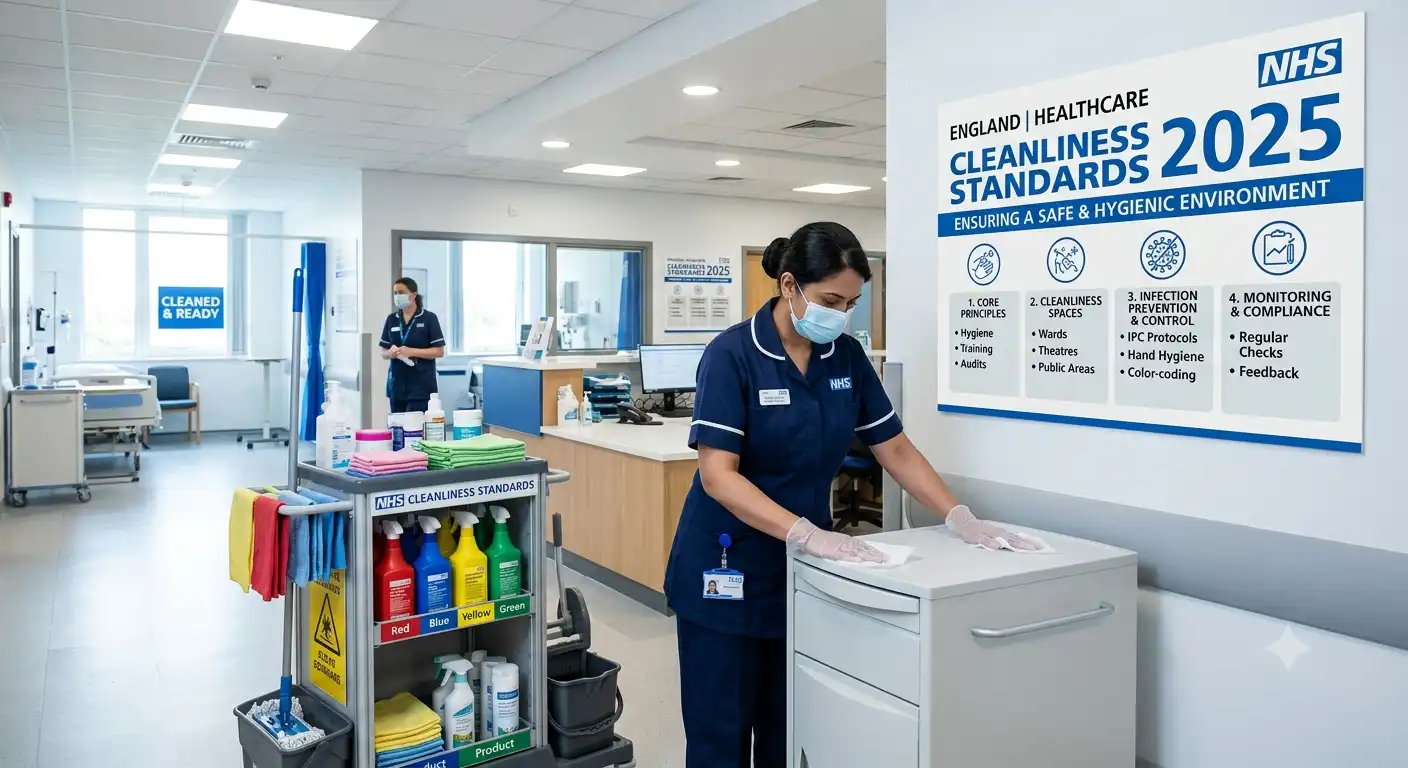
The 2025 National Standards of Healthcare Cleanliness, published by NHS England (the full standard is available on the NHS England website), provide a structured framework linking every cleanable area in a healthcare setting to a Functional Risk (FR) category, a minimum cleaning frequency, and an audit target score. This updated edition replaces the 2021 standards and introduces six FR categories (up from four), explicit coverage of ambulance trusts and patient transport, and a new public-facing Commitment to Cleanliness Charter.
If you manage cleaning across a healthcare site, you'll already know that "clean" isn't a single, obvious standard — a busy operating theatre and a quiet admin office simply don't need the same level of attention. Treating them as though they do wastes money in one place while leaving genuine risk unmanaged in the other. That's precisely the problem the NHS healthcare cleanliness standards were built to solve. If you're responsible for delivering against them, it's worth understanding the 2025 edition properly rather than skimming the summary and hoping for the best.
Overview: what you need to know
- The 2025 standards expand from four to six Functional Risk (FR) categories, giving far more precision than the previous system.
- Every cleanable area receives an FR rating, a target audit score, and a minimum cleaning frequency — frequencies cannot be reduced below the levels the standard specifies.
- Ambulance trusts and patient transport vehicles are now explicitly covered, adding eight new elements (numbers 53–60) to the original fifty.
- A public-facing star rating must be displayed at main entrances, alongside a signed Commitment to Cleanliness Charter.
Why the NHS healthcare cleanliness standards exist
Poor environmental hygiene in healthcare settings is directly linked to the spread of healthcare-associated infections (HCAIs). A facility that cannot demonstrate consistent, evidenced cleaning practice is exposed both clinically and reputationally. The NHS healthcare cleanliness standards give every NHS organisation — and increasingly primary care and independent providers — a shared framework for what "clean enough" actually means in any given space, rather than leaving it to local judgement or historical habit.
The standards work by linking a specific level of risk to every functional area of a building, then attaching a matching cleaning frequency, an audit target, and clear ownership of responsibility. In practice, this prevents a high-risk area such as a treatment room from being cleaned to the same schedule as a corridor rarely used during the day.
The same logic increasingly reaches beyond hospitals. GP practices are expected to align with the standards under CQC Regulation 15, and care homes face equivalent scrutiny — CQC inspectors expect premises to be visibly clean, with documented schedules matched to the care being delivered, daily cleaning of bedrooms and communal areas, and frequent disinfection of high-touch surfaces.
What changed in the 2025 NHS cleanliness standards?
The 2025 update is not a cosmetic refresh of the 2021 edition. The key changes are:
1. Six Functional Risk categories instead of four
The most significant structural change is the move from four risk categories to six FR categories, running FR1 (the highest risk, tightest standard) through to FR6 (the lowest risk, least frequent monitoring). Organisations already established on the four-category system from 2021 can continue using it, but the six-tier model allows considerably more precise matching of cleaning frequency to actual risk, rather than grouping moderately different spaces into the same broad band.
2. Expanded scope: ambulance trusts and patient transport
The 2025 standards explicitly cover ambulance trusts and patient transport vehicles for the first time. This pushes the total number of defined cleaning elements from fifty to sixty, with elements 53 through 60 specifically addressing ambulance cleaning. If your remit includes transport fleets, this is now a formal part of the standard, not an afterthought.
3. Stronger cross-team collaboration
Rather than treating individual elements within a room as separate jobs owned by whichever team happens to be responsible, the 2025 standards push towards cleaning entire functional areas coherently, with clear accountability regardless of whether the work is carried out by domestic services, nursing, or estates staff.
Understanding the six Functional Risk categories
Every cleanable clinical and non-clinical area must be allocated to one of the six FR categories before any other aspect of the standards can be applied. The FR category determines the cleaning frequency, the audit frequency, and the target score an organisation is expected to achieve. The examples below are indicative — the standard itself defines the allocation criteria.
| Category | Risk level | Indicative areas |
|---|---|---|
| FR1 | Highest | Operating theatres, critical care and other high-acuity clinical environments |
| FR2 | High | General wards, emergency departments, treatment rooms |
| FR3 | Moderate | Outpatient clinics and lower-acuity clinical areas |
| FR4 | Low-moderate | Non-clinical patient-facing areas such as waiting rooms |
| FR5 | Low | Circulation areas — corridors, stairwells, lift lobbies |
| FR6 | Lowest | General administrative offices and plant areas |
Getting categorisation right is the most consequential single step in implementation. Miscategorise a busy treatment room as lower risk than warranted, and you'll be under-cleaning against the actual clinical activity taking place there — a gap unlikely to surface until something goes wrong.
Categorisation should also be treated as a living decision rather than a one-off exercise. Clinical activity in a space can shift over time: a room repurposed for a higher-acuity use, a department that has expanded its hours, a corridor that has become a thoroughfare for a new service. Building a periodic review of FR allocations into annual planning catches these changes before they become an audit finding.
How the audit and scoring system works
Once an area has its FR category, the standards attach a target audit score measured in two parallel ways: a percentage score used for internal management and a star rating displayed publicly at entrances and in circulation areas.
The audit process operates across three distinct types:
- Technical audit: Measures cleanliness outcomes against the safe standard for that FR category — essentially, does the area look and test as clean as it should?
- Efficacy audit: Examines the process behind the outcome, including correct colour coding, appropriate equipment and materials, the right methodology, and whether supporting policies are genuinely being followed.
- External audit: Provides independent quality assurance over both of the above, offering a check that is not solely reliant on internal self-assessment.
For facilities managers, the practical implication is clear: you cannot present a clean-looking room and call it compliant. The 2025 standards require periodic efficacy audits carried out by multidisciplinary teams — typically including cleaning staff, nursing representatives, infection prevention and control specialists, and estates colleagues — so the process is reviewed from more than one professional angle.
Are NHS cleaning frequencies a requirement or a recommendation?
The cleaning frequencies attached to each FR category are safe minimums, not aspirational targets. The 2025 standards state explicitly that frequencies must not be reduced below the suggested levels, because those levels represent the safe baseline for meeting performance parameters and achieving the target audit score for that category.
This matters as much in budget conversations as it does clinically. It is tempting, when costs are under pressure, to consider stretching cleaning intervals in lower-traffic areas. The standards provide a defensible floor: areas can be scheduled less frequently if their FR category genuinely supports it — which is exactly the efficiency gain the risk-based system is designed to deliver — but that reduction must be justified by the FR category, not driven by budget pressure alone. For context on what those budget conversations involve, see our guide to commercial cleaning costs by property type — medical premises sit at the top of the commercial pricing range for exactly the reasons this standard exists.
The Commitment to Cleanliness Charter and public star rating
The 2025 standards introduce a formal Commitment to Cleanliness Charter: a public statement of an organisation's commitment to consistent cleanliness, built around the FR categories, cleaning frequencies, and responsibilities defined for each area. It must be displayed prominently — near ward and department entrances, outside public lifts, and in general circulation areas, not filed in an office.
Alongside the charter, healthcare providers are required to display a public-facing star rating at main entrances, reflecting the cleanliness of the whole functional area regardless of which staff group is responsible for cleaning it. For facilities managers, this means the standard being delivered against is no longer solely an internal management metric — it is visible to patients and visitors from the moment they enter the building.
Practical steps for facilities managers
If you're responsible for delivering against the 2025 NHS healthcare cleanliness standards, the following steps follow directly from the requirements:
- Document FR categorisations for every functional area and review them periodically — a space's clinical activity and usage can change over time.
- Appoint a named cleaning lead with clear oversight. This is increasingly expected as standard practice and is a specific requirement under CQC Regulation 15 for GP practices.
- Produce and maintain documented cleaning schedules with adequate resourcing to deliver the required frequencies. For CQC purposes, the evidence set typically means documented schedules, signed cleaning records, regular hygiene audits scored against targets, and cleaning risk assessments explaining why each area is cleaned at its frequency.
- Establish governance that reviews cleaning performance at board or senior management level, not solely at an operational level.
- Write compliance into contracted cleaning arrangements explicitly, including audit requirements. Staff working for external providers need genuine familiarity with the standards, not just a general awareness that NHS requirements exist — the same applies across public sector cleaning contracts more broadly.
- Plan and resource multidisciplinary efficacy audits — these cannot be completed by a single domestic services manager and must involve representatives from nursing, infection prevention and control, and estates.
- Integrate ambulance and patient transport fleet cleaning into the same governance structure as fixed sites. The eight new elements carry their own documentation requirements and cleaning frequencies, and an external auditor will expect to see them treated with the same rigour as any ward or clinic.
If your cleaning provider can't speak this language — FR categories, efficacy audits, evidence trails — that's a gap worth closing before your next external audit. Talk to us about compliance-ready cleaning for healthcare and clinical settings.
Frequently Asked Questions
Do the 2025 NHS healthcare cleanliness standards apply to GP practices and primary care, or only to hospitals?
The standards apply across healthcare settings, including general practice. There is an increasing expectation that GP practices have a named cleaning lead, documented schedules, and governance oversight aligned with CQC Regulation 15. Care homes face equivalent expectations under the same regulation, with documented schedules matched to the care being delivered.
Can an organisation still use the old four-category system rather than the new six?
Yes. Organisations already established on the four-category system from 2021 can continue using it. However, the six FR categories introduced in 2025 allow considerably more precise matching of cleaning frequency to actual risk.
Are cleaning frequencies in the standards a recommendation or a requirement?
They are defined as safe minimums rather than recommendations. The standards state that cleaning frequencies must not be reduced below the suggested levels, as these represent the baseline needed to meet target audit scores for each FR category.
What is the difference between a technical audit and an efficacy audit?
A technical audit checks the cleanliness outcome against the safe standard for that area. An efficacy audit examines the process behind it — correct colour coding, equipment, methodology, and adherence to supporting policy — and is typically carried out by a multidisciplinary team.
When did the 2025 NHS cleanliness standards come into effect, and do they replace the 2021 edition entirely?
The 2025 edition, published by NHS England, replaces the 2021 standards. Organisations previously operating under the 2021 four-category framework may continue to do so, but must ensure any new elements — including ambulance and patient transport coverage — are incorporated into their existing governance structures.
What happens if an area is miscategorised under the wrong Functional Risk category?
Miscategorisation — particularly assigning a higher-risk area to a lower FR category — can result in under-cleaning relative to the clinical activity taking place. This creates an infection risk that may not surface until an adverse event or a failed external audit.