

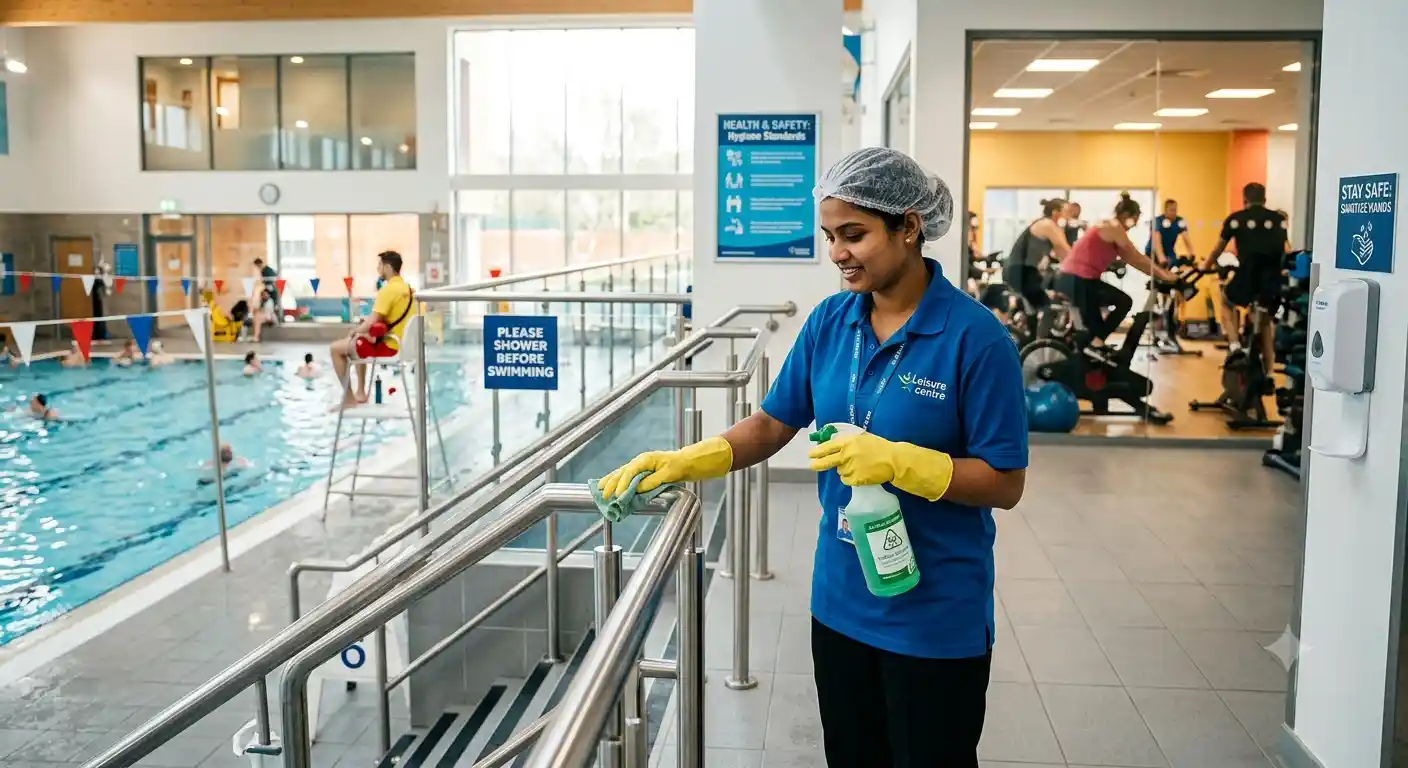
Leisure Centre Hygiene: Standards for Pools, Gyms & Changing Rooms
Leisure centre hygiene requires a higher standard than most commercial buildings. Warm, humid, heavily used spaces — pools, showers, changing rooms, gym floors — create ideal conditions for bacteria to multiply, and the regulatory framework reflects that. This guide covers what facility managers need to know across pool water management, Legionella control, gym equipment disinfection, and documentation requirements.
The essentials at a glance
- Pool water must be tested frequently — PWTAG practice is before opening, roughly two-hourly during use, and again after closing, with twice daily as the absolute minimum while a pool is in use.
- Legionella risk management is a legal duty under HSE's ACoP L8 — leisure facilities rank among the higher-risk premises due to warm, complex water systems.
- Gym equipment handles, seats, and mats need disinfecting multiple times daily, not only at opening and closing.
- Cleaning schedules and risk assessments must be documented and available for inspection — verbal assurance is not sufficient if a regulator asks.
The four hygiene zones at a glance
| Zone | Key requirement | Frequency | Governing guidance |
|---|---|---|---|
| Pool water | Chemical testing and dosing within defined ranges | Before opening, ~2-hourly in use, after closing | PWTAG Code of Practice |
| Water systems (showers, spas, steam rooms) | Written Legionella risk assessment and monitoring | Reviewed at least every 12 months | ACoP L8 / HSG282 for spa pools |
| Gym floor and equipment | Disinfection of high-touch surfaces | Multiple times daily | Industry practice standard |
| Changing rooms | Antibacterial cleaning and ventilation | Regularly throughout the day | Industry practice standard |
Why leisure centre hygiene carries greater risk than most buildings
Leisure centres pose a higher hygiene risk than typical commercial buildings because of the combination of warm water, high humidity, and constant shared skin contact. These conditions allow bacteria such as Legionella and Pseudomonas to establish themselves quickly if systems are not properly managed. Hundreds of people sharing the same shower heads, gym mats, and changing room benches creates a transmission risk that most other commercial premises simply do not face.
This is the reasoning behind why pools and leisure facilities fall under specific, detailed regulatory guidance rather than general commercial cleaning standards. If you manage one of these sites, the standards are not bureaucratic box-ticking — they exist because the underlying risks are real and well documented.
Pool water management: what PWTAG guidance requires
The short answer: Pool water must be tested before opening, roughly every two hours throughout operating hours, and again after closing. Free chlorine and pH must be kept within defined ranges throughout.
The Pool Water Treatment Advisory Group (PWTAG) publishes the Code of Practice that functions as the de facto national standard for swimming pool cleaning standards and water management in the UK. PWTAG is not a government body, but HSE explicitly recognises its guidance as the benchmark enforcing authorities expect operators to meet — making it essential reading rather than optional best practice.
How often should pool water be tested?
PWTAG recommends testing before the pool opens, roughly every two hours during operating hours, and once more after closing. Pool water chemistry shifts continuously as bathers, sunlight, and disinfectant use interact. Infrequent testing will not catch problems before they become a genuine hazard to swimmers.
What chemical levels does pool water require?
Chemical balance matters as much as testing frequency. For swimming pools, where hypochlorite is used at a pH of 7.2, PWTAG's target is to maintain free chlorine at approximately 1 mg per litre, with 0.5 mg per litre as an absolute floor that must never be dropped below. Spa pools and hot tubs are treated differently: HSE's dedicated spa-pool guidance (HSG282) calls for higher free chlorine residuals of 3 to 5 mg per litre, pH maintained between 7.2 and 7.8, and a minimum of twice-daily testing while the spa is in use — reflecting the higher bacterial risk of warm, heavily loaded water. Facilities pursuing PWTAG PoolMark accreditation are formally demonstrating consistent compliance with the PWTAG benchmark.
Handling pool incidents correctly
Beyond routine testing, leisure centre hygiene standards govern what happens when something goes wrong in the water — a faecal incident, vomiting, or blood from a graze. These situations require documented, rehearsed procedures rather than improvised responses. Getting the response wrong, or delaying it, genuinely increases infection risk for everyone using the water at the time.
Staff need to know immediately whether an incident requires evacuating the pool, how long the pool must remain closed, and what additional chemical treatment is required before it is safe to reopen. This procedure should be written down, trained on regularly, and readily available to any staff member on poolside duty.
Different incident types require different closure times. A formed-stool faecal incident typically requires a shorter closure than a diarrhoeal one, because the latter carries a significantly higher risk of cryptosporidium contamination — a pathogen that standard chlorine levels do not neutralise quickly. Staff who understand this distinction can respond proportionately, rather than either overreacting to a minor incident or underestimating a genuinely higher-risk one.
Legionella control: a legal duty, not a recommendation
The short answer: Under ACoP L8, leisure facility operators have a legal duty to assess and control Legionella risk. Warm water features — showers, spa pools, hot tubs, steam rooms — make leisure centres among the highest-risk premises in this category.
Under the Health and Safety at Work Act 1974 and the associated Approved Code of Practice ACoP L8, facility operators carry a legal obligation to assess and manage Legionella risk in their water systems. Leisure centres sit among the higher-risk premises because their water systems include showers, spa pools, hot tubs, and steam rooms that operate in the 20–45°C range where Legionella bacteria multiply most readily. Spa pools are widely regarded as the single highest-risk feature of any commercial water system: they run at body temperature, carry organic load from bathers, and aerosolise water directly into users' breathing zones.
Why Legionella cannot be managed by eye
Legionella lives within the water system itself — in pipework, tanks, shower heads, and spa pool circulation — rather than on visible surfaces. It cannot be assessed by appearance alone. Proper testing, monitoring, and where necessary, chemical or thermal treatment carried out by a competent person are required. A written risk assessment is the legal minimum, and it must be reviewed regularly — at least every 12 months in practice, and sooner after changes to the water system, positive test results, or prolonged periods of low occupancy. A professional Legionella risk assessment for leisure premises typically costs £500–£1,500, depending on the size of the building and the number of water systems.
Gym floor and equipment hygiene: managing high-touch surfaces
The short answer: High-touch gym surfaces — handles, seats, and mats — must be disinfected multiple times throughout the day, not just at opening and closing. Visible sanitising stations and staff-led cleaning rounds are both required in practice.
Every handle, seat, grip, and mat is touched by dozens or hundreds of different people across a single day, often by hands that have just wiped sweat from a face or adjusted equipment mid-set. This pattern of high-frequency shared contact is highly efficient at spreading everyday bacteria and viruses.
The practical standard requires high-touch surfaces to be disinfected multiple times during the day, particularly during busy periods. This typically means combining staff-led cleaning rounds with encouraging members to wipe equipment themselves between uses, supported by well-stocked sanitising stations positioned where people will actually use them.
Flooring considerations
Cleaning products used on gym floors must leave surfaces properly dry and free of residue. A slippery floor in an area where people are lifting weights or moving quickly is an entirely preventable injury risk — one that comes down to correct product selection and allowing sufficient drying time between cleans.
Changing room hygiene: the overlooked risk zone
Changing rooms often receive less attention in leisure centre hygiene programmes than pools or gym floors — but they arguably warrant equal scrutiny. Warm, humid, and persistently damp from showering members, changing rooms are a near-perfect environment for fungal and bacterial growth if cleaning is not frequent and thorough.
Antibacterial cleaning must be carried out regularly throughout the day, not just as an end-of-day routine. Particular attention is needed in moisture-prone areas — corners, under benches, and around shower areas where standing water collects unnoticed. Ventilation matters almost as much as cleaning products: a well-ventilated changing room dries between uses and slows bacterial growth considerably, whereas a poorly ventilated one stays damp throughout the day regardless of how often it is mopped.
Locker handles also deserve specific attention. Touched by dozens of different hands daily yet rarely included in standard cleaning rounds, they represent an overlooked transmission route for the same bacteria that hygiene programmes carefully manage elsewhere in the building.
Documentation: proving the standard, not just meeting it
One principle runs through every element of leisure centre hygiene compliance: verbal assurance is not sufficient. Cleaning schedules, water testing logs, Legionella risk assessments, and incident response records must all be documented and kept readily available for inspection. Regulators and enforcing authorities expect to see evidence of a functioning system, not a manager's word that standards are being met.
Documentation also serves a practical function beyond legal compliance. A documented schedule makes it immediately visible when a task has been missed, rather than relying on staff memory across shift changes. It also protects a facility if something goes wrong — a clear, consistent paper trail demonstrating due diligence is a materially different position than having nothing to show beyond good intentions.
Building a workable leisure centre cleaning programme
Given how different pools, gym floors, and changing rooms are in terms of risk profile and required treatment, the most effective approach to leisure centre cleaning is a structured programme that addresses each zone according to its specific requirements:
- Pool water — a dedicated testing regime with trained technical operators
- Legionella management — a written risk assessment with a monitoring schedule reviewed on a set cycle, not only when prompted by concerns
- Gym equipment — frequent, visible disinfection built into staff rounds throughout opening hours
- Changing rooms — regular antibacterial cleaning paired with genuinely effective ventilation
Staff training underpins the entire programme. A cleaning schedule is only as effective as the people carrying it out. Given how technical some requirements are — chemical dosing, incident response procedures, Legionella awareness — proper training is a core operational requirement, not an optional extra. When budgeting for a programme of this scope, our guide to commercial cleaning price benchmarks shows where leisure and high-hygiene premises sit against other property types.
Building in genuine accountability matters too. Named responsibility for each zone, clear escalation routes when something is found to be wrong, and periodic internal audits that check whether the documented schedule reflects what is actually happening on the ground all help close the gap between policy and practice. A cleaning programme that exists only on paper is arguably more dangerous than an honest, imperfect one — because it creates false confidence that risks are being managed when they may not be.
If you'd rather have the zoned approach delivered by a team that already works this way, our specialist leisure centre cleaning covers gym floors, changing rooms, and poolside areas — discuss a zoned cleaning programme with us and we'll scope it around your site.
Frequently Asked Questions
How often should pool water be tested in a leisure centre?
According to PWTAG guidance, pool water should be tested before opening, roughly every two hours throughout operating hours, and again after closing. Pool chemistry shifts continuously with bather load and disinfectant use, making frequent testing essential.
Why are leisure centres considered higher risk for Legionella than most buildings?
Leisure centre water systems combine warm temperatures, complex pipework, and features such as spa pools, hot tubs, and showers that operate in the 20–45°C range where Legionella bacteria multiply most readily. Under ACoP L8, this makes formal risk assessment a legal requirement rather than an advisory measure, with reviews at least every 12 months in practice.
How often should gym equipment be disinfected during opening hours?
High-touch items — handles, seats, and mats — should be disinfected multiple times throughout the day, particularly during busy periods, rather than only at opening and closing. The volume of different users touching these surfaces throughout a single day makes infrequent disinfection insufficient.
What records must leisure facilities keep for hygiene compliance?
Facilities must maintain documented cleaning schedules, pool water testing logs, Legionella risk assessments, and incident response records, all of which should be readily available for inspection. Regulators expect evidenced compliance, not verbal reassurance.
What is PWTAG PoolMark accreditation?
PoolMark is a formal accreditation offered by the Pool Water Treatment Advisory Group (PWTAG) that recognises leisure facilities which consistently meet PWTAG's Code of Practice standards for pool water management. Achieving it demonstrates ongoing compliance rather than occasional adherence to the benchmark.