
Office cleaning for hybrid workplaces: what's changed post-2025
Hybrid workplace cleaning strategies have become essential for any business still operating on a fixed pre-pandemic cleaning schedule — because that schedule was built for an office that no longer exists. Hybrid working has permanently changed which parts of an office get used, when, and by how many people. Cleaning contracts that haven't kept pace are either wasting money on empty rooms or under-servicing the days that actually matter.
Where the Office Actually Stands Now
- 28% of working adults in Great Britain hybrid worked between January and March 2025, with that proportion rising steadily since 2022.
- By March 2026, around 13% worked from home exclusively and a further 28% split their time — meaning fewer than half of the workforce commutes in every day.
- Hot-desking workplaces show 18% higher bacterial contamination than fixed-desk offices, according to Initial Washroom Hygiene research.
- The majority of UK businesses now operate some form of hybrid model, making occupancy-based cleaning far more relevant than fixed daily schedules.
Why fixed cleaning schedules no longer make sense
Fixed cleaning schedules fail hybrid offices because they assume consistent, predictable weekday occupancy — an assumption that no longer holds for the majority of UK businesses.
A pre-pandemic office cleaning contract typically assumed a fairly predictable pattern: most desks occupied most weekdays, consistent washroom use, and a kitchen that saw steady traffic throughout the working week. With 28% of working adults in Great Britain now hybrid working, offices see genuinely uneven occupancy across the week.
The practical effect is a building that might be near capacity midweek and largely empty either side of it. Cleaning the same rooms to the same standard on both types of day either wastes money on the quiet days or — more commonly — leaves the busy days under-serviced, because the contract was priced around an average that doesn't actually exist on any single day.
What does occupancy-driven cleaning actually look like?
Occupancy-driven cleaning means adjusting the frequency and intensity of cleaning based on how a building is actually being used that day or week, rather than following a static specification written once and left unchanged.
A typical hybrid office shows a fairly consistent pattern across the week:
| Day pattern | Typical occupancy |
|---|---|
| Tuesday to Thursday | 70% or higher |
| Monday and Friday | 30% or lower |
This isn't simply "clean less on quiet days", though cost savings are part of the appeal. It's closer to redirecting the same overall cleaning effort toward where it delivers real value — a packed midweek day getting proper attention on high-touch surfaces and washrooms, while a quiet Monday sees a lighter, more targeted pass rather than a full service nobody's there to benefit from.
Making this work well typically depends on some visibility into actual occupancy, whether that's building access data, desk-booking system figures, or simply a manager's realistic sense of which days genuinely fill up. Cleaning contracts increasingly build in this kind of flexibility explicitly, with agreed core service levels plus scalable extras tied to occupancy thresholds, rather than expecting a cleaning provider to guess.
The hot-desking hygiene problem hybrid working created
Hot-desking environments carry 18% higher bacterial contamination than fixed-desk offices, according to Initial Washroom Hygiene research — increasing the risk of cross-contamination and the spread of colds, flu, and norovirus.
The same study found the gap is even starker on specific surfaces: shared computer mice ran 41% higher in microbiological readings, and desk surfaces 32% higher, compared to their fixed-desk equivalents.
Hot-desking was already common before hybrid work became standard, but hybrid working has made it near-universal, and that shift has a genuine hygiene cost. A fixed desk gets used — and implicitly maintained — by one person who has some incentive to keep their own space reasonably clean. A hot desk gets used by a rotating cast of people across a week, none of whom feel individually responsible for its cleanliness, and all of whom are touching keyboards, mice, and phone handsets that a cleaning schedule built for fixed desks was never really designed around.
High-touch surfaces are where this matters most. Keyboards, mice, and shared telephone handsets are consistently flagged as the worst offenders in office hygiene research, and a hot-desking environment multiplies the number of different hands touching each of these surfaces across a single week.
How to build a hot-desk cleaning policy that actually works
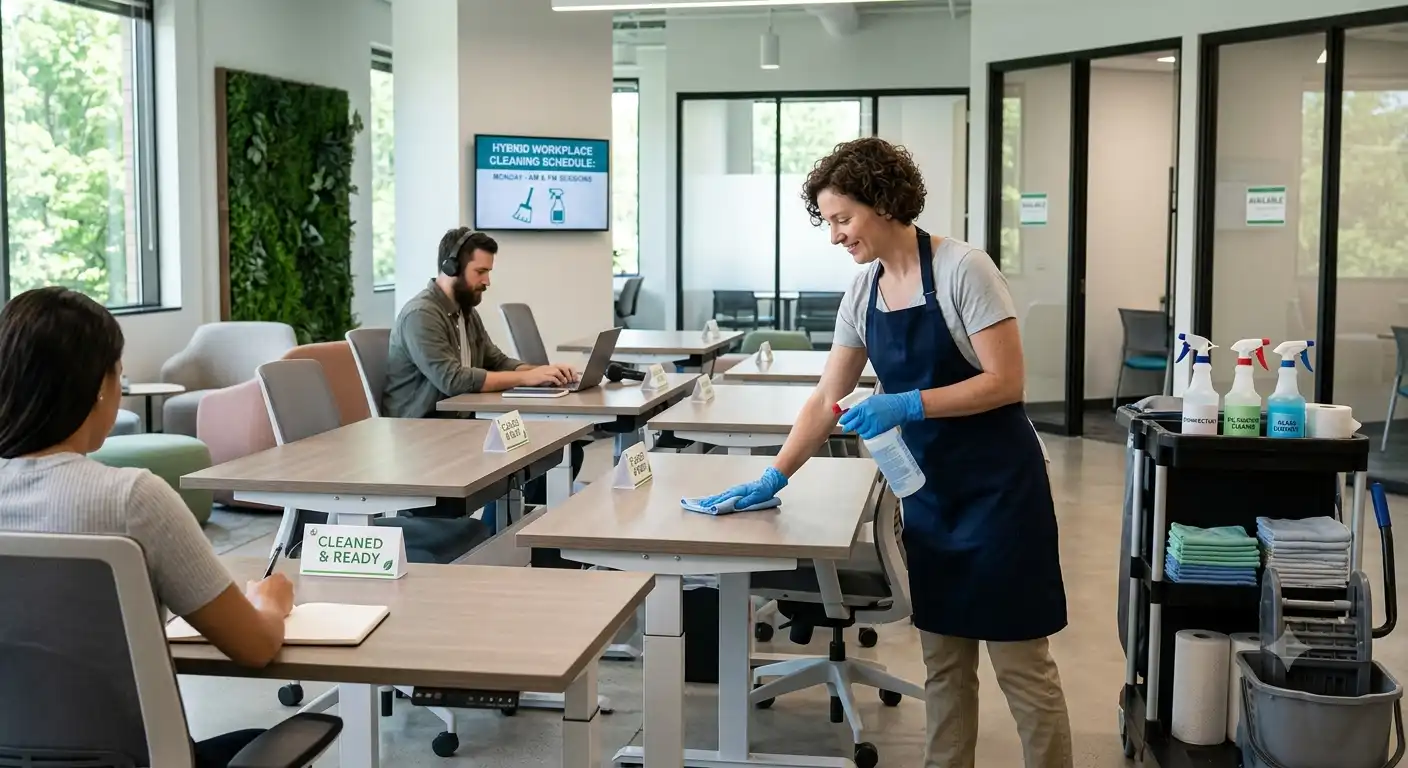
A workable hot-desk cleaning policy combines two layers: professional cleaning targeted at high-touch surfaces at agreed intervals throughout the day, and simple end-of-use protocols that staff themselves are asked to follow.
With hybrid working now the norm across most UK businesses, a documented hot-desk cleaning policy has moved from nice-to-have to genuinely expected practice — covering both the professional cleaning layer and the staff-facing end-of-use steps is what separates offices that manage this well from those relying on goodwill alone.
The professional layer needs to specifically target desk tops, keyboards, mice, and shared phones — at a frequency that matches actual desk turnover rather than the building's general cleaning schedule. A desk that turns over three or four times in a day needs considerably more attention than the general office cleaning rota was built to provide.
The staff-facing layer matters just as much, even though it's harder to enforce consistently. Simple, genuinely quick steps — a wipe with provided sanitising wipes before and after using a shared desk, clearing personal items at the end of a session — cost almost nothing to implement. Reliable uptake usually means visible wipe stations at desks and a clear, brief policy communicated properly, rather than buried in a handbook nobody reads. If you'd like this built into a proper service specification, our contract cleaning team can structure the professional layer around your actual desk turnover.
The hygiene anxiety cost businesses are underestimating
Poor hot-desk hygiene carries a measurable human cost. A 2024 survey found that hygiene anxiety affected 40% of UK office workers, contributing to lower engagement and higher turnover in businesses where staff felt their workspace wasn't being properly maintained.
This is a genuinely underappreciated angle in the hybrid workplace cleaning conversation — the psychological effect of walking up to a hot desk that visibly hasn't been wiped since the last person left. The flip side is equally worth noting. Businesses that prioritise a visible, well-communicated hot-desk cleaning policy report staff feeling more respected in their workspace, with productivity running around 15% higher on average where hygiene concerns have genuinely been addressed.
Cleaning quality in a hybrid office, in other words, isn't purely a facilities issue — it measurably touches morale and output in ways that are easy to underestimate when budgeting a cleaning contract.
Making the most of quieter office days
One of the more practical hybrid workplace cleaning strategies is using naturally quieter days to schedule deeper cleaning that would be disruptive in a fully occupied office.
Carpet extraction, upholstery cleaning, and thorough cleaning of areas that are awkward to access around a full desk of people all fit more sensibly into a quiet Monday or Friday than into a packed midweek day. This approach effectively turns the uneven occupancy pattern that hybrid working created into a genuine planning advantage. Rather than treating quiet days as simply "less cleaning needed", the smarter response schedules deep, disruptive work that would otherwise need doing out of hours or over a weekend — at extra cost — into a day when the office is naturally emptier anyway.
Meeting rooms and shared spaces: a different occupancy pattern entirely
Meeting rooms and collaborative spaces often become busier relative to individual desk space under hybrid working, as teams use in-office days specifically for collaborative work that's harder to do remotely.
Video-conferencing equipment, shared whiteboards and touchscreens, and meeting room surfaces generally now see concentrated use on specific days — often clustered around the days when most of a team happens to be in simultaneously. A cleaning specification that treats meeting rooms the same as general office floor space misses the fact that these spaces may now carry disproportionate wear relative to their size, precisely because hybrid scheduling concentrates their use into fewer, busier days.
How digital tools support smarter hybrid cleaning schedules
A growing share of UK cleaning firms are adopting digital scheduling and occupancy tools to improve efficiency. For hybrid office environments specifically, this often means occupancy-tracking software feeding directly into cleaning schedules, rather than cleaning teams working from a fixed, static rota. Businesses using this kind of integration report measurable improvements in both efficiency and cost, largely because effort stops being spent on spaces that genuinely weren't used that day.
This doesn't need to mean an elaborate technology overhaul for every office. Even relatively simple integration — a shared calendar of expected in-office headcount, or basic desk-booking data shared with the cleaning provider — gives a cleaning team enough to adjust intensity sensibly without needing full building-access analytics. The principle matters more than the sophistication of the tool: cleaning that responds to actual, known occupancy rather than an assumption baked into a contract years ago.
The kitchen and breakout space problem nobody planned for
Shared kitchens and breakout areas have become one of the trickiest spaces to clean well under hybrid working, because their busiest moments are now harder to predict than they used to be.
A kitchen that saw a fairly even trickle of use throughout a traditional five-day week now sees genuine peaks on the days most of a team happens to be in, and near-silence on the days it isn't. This makes a fixed daily cleaning slot considerably less useful than it once was. The practical fix mirrors the approach to desks: build cleaning intensity around actual, known busy days rather than spreading a fixed amount of attention evenly across the week. Teams that deliberately cluster collaborative work into the middle of the week — which has become a common hybrid pattern — create predictable peaks that a cleaning schedule can genuinely plan around, provided the cleaning provider actually knows the pattern exists.
What hybrid working means for cleaning budgets
Occupancy-based hybrid workplace cleaning strategies don't necessarily cost more — but they do deliver noticeably better value by concentrating spend where the building's real usage patterns create pressure.
A natural concern when moving away from a fixed schedule is that occupancy-based cleaning will simply mean paying for the same service in a more complicated way. In practice, most businesses making this switch find total spend stays broadly similar, but value improves noticeably, since money isn't being spent cleaning empty rooms on quiet days. For a sense of typical UK office cleaning rates before any occupancy adjustment, our commercial cleaning cost breakdown covers pricing by property type and frequency.
The bigger budget consideration is usually the hygiene-specific spend around hot-desking — sanitising wipes, additional high-touch surface cleaning, and staff-facing hygiene stations — which is a genuinely new cost line for many offices. This is worth budgeting for explicitly rather than trying to absorb it into an existing cleaning line, since it addresses a distinct risk that simply didn't exist in the same way before hot-desking became standard practice.
Getting the cleaning contract right for how your office works now
The practical takeaway for anyone reviewing an office cleaning contract post-2025 is that the old assumption of steady, predictable weekday occupancy no longer reflects reality for most hybrid businesses.
A contract worth paying for now needs to name actual in-office patterns explicitly — which days are genuinely busy, which spaces see concentrated use, and where hot-desking specifically needs a documented, higher-frequency hygiene response. Getting this right isn't necessarily about spending more. It's about making sure the cleaning budget is actually going where the building's real usage patterns put the pressure, rather than being spread evenly across a week that, for most hybrid offices, simply doesn't look even anymore. If your office is based in Scotland, our Edinburgh commercial cleaning team can review your current contract against your actual occupancy pattern, and you're welcome to browse the rest of our cleaning services in the meantime.
Frequently asked questions
How much has hybrid working actually grown in the UK by 2026?
By March 2026, roughly 13% of people in Great Britain worked from home exclusively, with a further 28% splitting time between home and office — meaning fewer than half of the workforce now commutes in on any given day, a substantial shift from pre-pandemic patterns.
Is hot-desking really less hygienic than fixed desks?
Research from Initial Washroom Hygiene found bacterial contamination running 18% higher in hot-desking environments compared to fixed-desk offices — with shared mice 41% higher and desk surfaces 32% higher on specific measures — largely because no single person feels responsible for maintaining a desk that multiple people use across a week.
Should office cleaning frequency change based on which days are busiest?
Yes — this is the core idea behind occupancy-driven cleaning. Matching cleaning intensity to actual in-office headcount, rather than following a flat weekly schedule, avoids both wasted spend on quiet days and under-servicing on genuinely busy ones. A typical hybrid office sees 70% or higher occupancy midweek, dropping to 30% or less either side.
Does a hot-desk cleaning policy really affect staff productivity?
Survey data from 2024 suggests it does. Hygiene anxiety affected 40% of UK office workers, while businesses with a clear, visible hot-desk cleaning policy report staff feeling more respected and around 15% more productive on average.
How do I know if my current office cleaning contract is still fit for purpose?
If your contract was written before 2020 or hasn't been reviewed since your business adopted hybrid working, it almost certainly reflects occupancy assumptions that no longer apply. Review it against your actual in-office patterns — specifically which days are busiest, which spaces see concentrated hot-desk use, and whether meeting rooms are serviced at a frequency that reflects their real usage.
What's the first step towards an occupancy-based cleaning model?
Start by mapping your real occupancy patterns: which days typically see the most staff in, which spaces carry the heaviest use, and where hot-desking is concentrated. Share this information with your cleaning provider and ask them to propose a contract structure that flexes around it, with agreed core service levels and scalable extras tied to occupancy thresholds.