
How Often Should You Get Carpets Professionally Cleaned?
Most households need a professional carpet clean every 12 to 18 months. However, the right frequency depends on your household — pets, children, allergies, and foot traffic can all push that figure closer to every six months, or even more often.
Most of us give the carpets a good hoover once a week and call it a day. Fair enough — it's what the carpet looks like that matters, isn't it? Except a carpet can look perfectly presentable while harbouring a fair amount of grime, dust mites and bacteria that a vacuum simply can't reach. So how often should you clean carpets professionally? The honest answer is: it depends on your household. Here's what the experts recommend, and why.
Ask around and you'll get wildly different answers. A friend with a spotless spare room might tell you she hasn't had hers touched in three years. Someone else with two dogs and a toddler will swear by twice-yearly visits. Both can be right, because carpet cleaning frequency isn't a one-size-fits-all figure — it's shaped by who and what walks across your floors every day.
How often should you clean carpets? The general rule
For an average UK household, the industry consensus is a professional deep clean every 12 to 18 months. This recommendation is backed by the National Carpet Cleaners Association (NCCA), the Carpet and Rug Institute, and major British manufacturers such as Brintons and Cormar Carpets — it's not a figure plucked from thin air.
There's a practical reason behind it, too. Many carpet warranties are conditional on regular professional cleaning. Skip it, and you could find your warranty void if the pile flattens prematurely or a stain becomes permanent. Manufacturers typically want to see evidence of hot water extraction cleaning — sometimes called steam cleaning — carried out roughly once a year by a certified technician. It's worth digging out your paperwork and checking, because the small print varies.
Think of it a bit like servicing a car. You don't wait until something breaks down before you take action; you stick to a schedule because it protects the investment. A £2,000 living room carpet left unloved for five years will look tired and worn long before its time — while replacing it can easily run into four figures once you factor in fitting. A yearly clean costing a fraction of that protects the fibres from the kind of grit-based wear that eventually shreds them from the inside. It's cheaper to maintain than to replace, every time.
Of course, 12 to 18 months is a starting point, not a rule carved in stone. Some homes need attention far more often.
Carpet cleaning frequency by household type
Your ideal carpet cleaning frequency depends on the number of people, pets, and activities in your home. A house with no pets, no children and light foot traffic can often stretch towards the 18-month mark without any trouble. Add life into the mix, though, and the maths shifts quickly.
| Household type | Recommended frequency |
|---|---|
| Standard household (no pets or children) | Every 12–18 months |
| Homes with pets | Every 6–12 months |
| Families with young children | Every 6 months |
| Smokers' households | Every 3–6 months |
| Allergy or asthma sufferers | Every 3–6 months |
| High-traffic areas (hallways, stairs, living rooms) | Every 6 months |
If more than one of these applies to your home, lean towards the shorter end of the range. A household with both pets and small children, for instance, is realistically looking at a clean every six months rather than twelve.
Renters have an extra reason to pay attention. Many tenancy agreements require carpets to be professionally cleaned before you move out, and letting agents will often check for a receipt before releasing your deposit. Booking a clean partway through a longer tenancy isn't a bad idea either — it keeps the flat in good order and gives you evidence, should there ever be a dispute about wear and tear.
Signs your carpet is overdue a professional clean
Schedules are useful, but your carpet will usually tell you when it's had enough, if you know what to look for.
A dull, flattened appearance is the most obvious clue — carpet fibres lose their bounce once dirt has ground its way in. Persistent odours are another giveaway, especially if they linger after you've aired the room out. If you're vacuuming regularly but the carpet still looks grubby around doorways and walkways, that's soil that's worked its way below the surface, out of reach of a standard vacuum.
Health symptoms matter too. It's a common misconception that a carpet which looks clean must be free of allergens. Dust mite populations can thrive deep in the pile while the surface looks spotless. If you or your family find sneezing, itchy eyes or a stuffy nose seem to ease when you're away from home, your carpet could be a contributing factor.
Another clue is how quickly rooms start to look dirty again after vacuuming. If a freshly hoovered carpet looks grubby again within a day or two, that's usually a sign that soil has worked so deep into the fibres that it's constantly rising back to the surface. No amount of extra vacuuming will fix that on its own — it needs the deeper extraction only a professional machine can provide.
According to research by Airmid Healthgroup, professional hot water extraction can cut surface dust mite allergen levels by up to 91%, cat allergen by 95%, and dog allergen by 97%. No amount of home vacuuming gets close to that.
Then there's the simple sniff test. Press your hand into the carpet near a doorway or under a rug that hasn't moved in a while, then have a smell. Musty or slightly sour odours are a strong sign that moisture and soil have built up in the underlay, not just the pile — something a surface clean won't touch.
What does a professional carpet clean actually do?
Professional carpet cleaning uses hot water extraction to remove deep-seated dirt, bacteria, and allergens that vacuuming cannot reach. It's worth understanding why this outperforms anything you can do with a rented machine or a bottle of shop-bought shampoo — our guide to the most effective carpet cleaning method compares the options in detail.
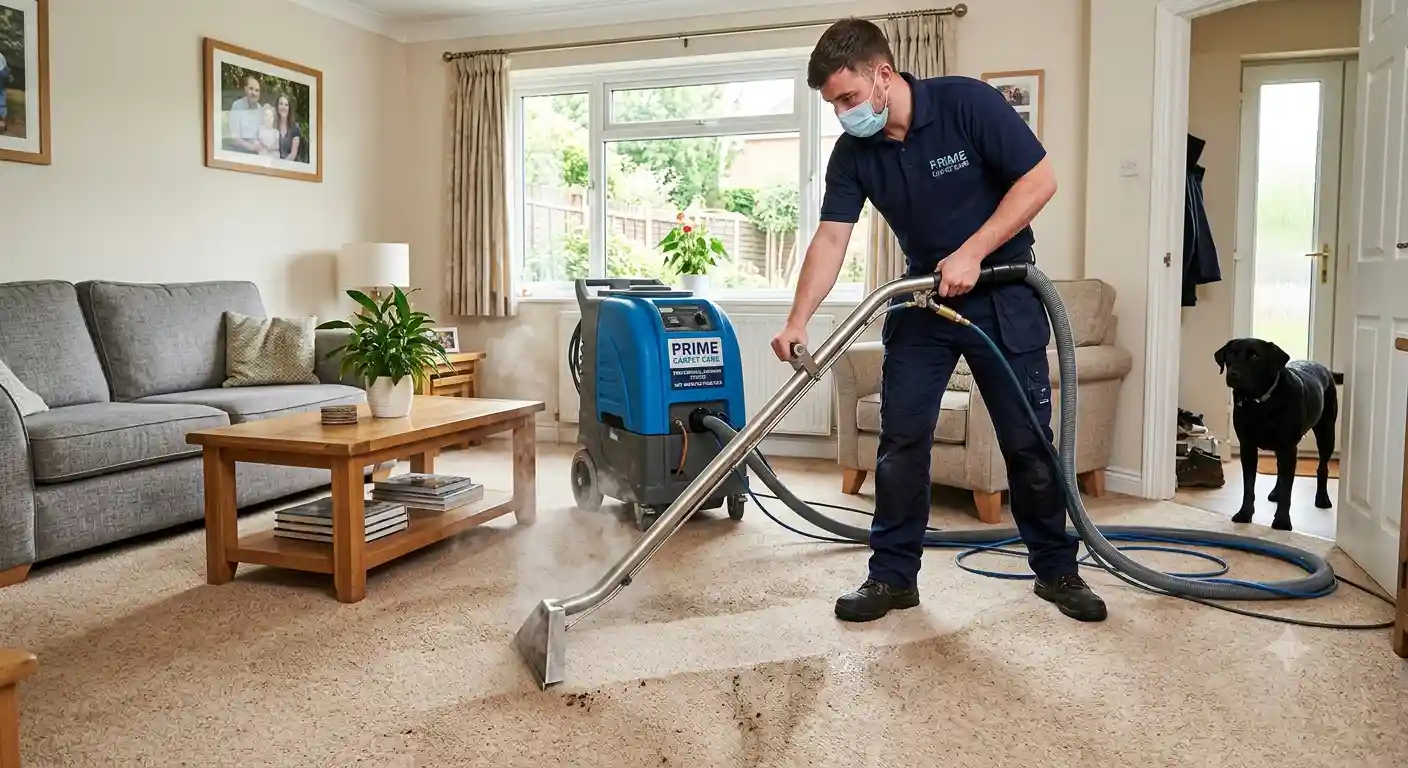
Most reputable UK cleaners use hot water extraction, where hot water and cleaning solution are injected deep into the carpet fibres under pressure, then immediately extracted along with the loosened dirt. It reaches soil trapped well below the surface, rather than just refreshing the top layer.
A domestic vacuum, even a good one, mostly lifts loose surface debris. It does very little against ground-in soil, bacteria or allergens bound to the fibres by oils and moisture. DIY carpet shampooers can help between professional visits, but they tend to use less powerful extraction, which means more moisture — and more residue — gets left behind. That residue can actually attract dirt faster afterwards, which is the opposite of what you want.
A professional clean also gives your carpet a proper drying time and, in many cases, a protective treatment afterwards to help repel future stains.
It's worth saying that between professional visits, regular hoovering still matters enormously. It stops loose grit acting like sandpaper on the fibres every time someone walks across the room, which is one of the main causes of premature wear. Professional cleaning and weekly vacuuming aren't competing tasks — they work together, one dealing with surface debris day to day, the other reaching what's settled in underneath.
How much does professional carpet cleaning cost in the UK?
Professional carpet cleaning typically costs £25–£55 per room in the UK, or £90–£250 for a whole home, depending on property size and the condition of the carpets. As a general guide for 2026:
| Job size | Typical cost |
|---|---|
| Per room | £25–£55 (or £1.50–£4 per m²) |
| 2-bedroom flat (all carpets) | £90–£150 |
| 3-bedroom house (all carpets) | £150–£250 |
| Pet odour or specialist stain treatment | £20–£50 extra |
Most companies set a minimum call-out charge of around £60–£80, so a single small room will usually cost the minimum rather than the per-room rate. Heavily stained carpets or pet odour treatment will push costs towards the top of these ranges, and London prices sit slightly higher — our carpet cleaning in London team can quote an exact figure for your postcode.
How to choose a professional carpet cleaner
When choosing who to book, look for accreditation with the NCCA or WoolSafe. Both organisations set standards of practice and require members to be properly trained, which matters when you're trusting someone with an expensive carpet. It's also worth asking exactly which method they use — hot water extraction is generally considered the most thorough — and whether they offer a receipt, since you may need one to keep a manufacturer's warranty valid.
A few other questions are worth putting to any company before you book. Ask how long the carpet will take to dry, since some cheaper methods leave excess moisture behind that can lead to mould in the underlay if the room isn't ventilated properly. Ask whether the price quoted includes furniture moving, or whether that's charged separately. And if a quote seems noticeably cheaper than everyone else's, it's worth finding out why — a genuinely thorough hot water extraction clean, with proper drying time and equipment, rarely comes in far below the going rate. Reading a handful of recent reviews, rather than relying on the testimonials on a company's own website, tends to give a more honest picture of what to expect.
A carpet is one of the more expensive things in any room, and it's also one of the easiest to neglect because the damage happens gradually rather than all at once. Get into a rhythm that suits your household, whether that's every six months or every eighteen, and it'll repay you in both appearance and air quality for years to come. If you'd like it handled properly, our expert carpet cleaning service uses hot water extraction and covers homes across the UK — get in touch for a no-obligation price.
Frequently Asked Questions
How often should you clean carpets if you have allergies?
Allergy and asthma sufferers should have their carpets professionally cleaned every 3 to 6 months. According to Airmid Healthgroup research, professional hot water extraction can reduce dust mite allergens by up to 91% and pet allergens by up to 97% — results that regular vacuuming cannot match.
Does professional carpet cleaning void your warranty?
No — in fact, the opposite is often true. Many carpet warranties require evidence of regular professional cleaning (typically hot water extraction by a certified technician) to remain valid. Skipping professional cleans could void your warranty if the pile flattens prematurely or a stain becomes permanent.
How long does carpet take to dry after professional cleaning?
Drying times vary by method and room ventilation, but most professionally cleaned carpets dry within 4 to 8 hours. Hot water extraction generally requires the least drying time compared to wet shampooing methods, provided the room is well ventilated. Always ask your cleaner for a realistic estimate before booking.
Is professional carpet cleaning worth it?
Yes, for most households. A professional clean costs a fraction of replacing a carpet, removes the deep grit that wears fibres out prematurely, keeps manufacturer warranties valid, and cuts allergen levels dramatically. A carpet cleaned every 12 to 18 months can comfortably outlast its expected lifespan; one left uncleaned for years usually looks worn well before its time.
Can I just rent a carpet cleaning machine instead?
Rental machines can help between professional visits, but they use weaker extraction than professional equipment. That means more moisture and detergent residue left in the pile — which can lead to longer drying times, a risk of mould in the underlay, and carpets that re-soil faster because the residue attracts dirt. For the deep annual clean, professional hot water extraction delivers results a rental machine cannot match.