
Hourly vs Fixed Price Cleaning: Which Is Better?
When comparing hourly vs fixed price cleaning, neither model is universally better — each suits different jobs, different homes, and different levels of predictability. Hourly pricing works best for unpredictable or one-off jobs; fixed pricing suits regular, well-understood cleans where both sides know exactly what's involved.
You've decided to get a cleaner. Good decision. Now comes the slightly less exciting part — working out how you're actually going to pay for it. Most UK cleaning companies and independent cleaners offer one of two models: an hourly rate, where you pay for the time worked, or a fixed price, where you agree a set fee for a defined job before anyone picks up a mop. Each suits different jobs, different homes, and different levels of trust between you and the person doing the cleaning. Here's how to work out which one is right for you.
At a Glance
- UK hourly cleaning rates typically run £14–£30, with independents cheaper than agencies and London running highest.
- Fixed pricing gives budget certainty and rewards efficient cleaners, but can lead to rushed work if the scope is misjudged.
- Hourly pricing suits unpredictable or one-off jobs; fixed pricing suits regular, well-understood cleans.
- Watch for hidden extras on both models — minimum call-out fees, supplies, and specialist add-ons like carpets or upholstery.
How does each pricing model work?
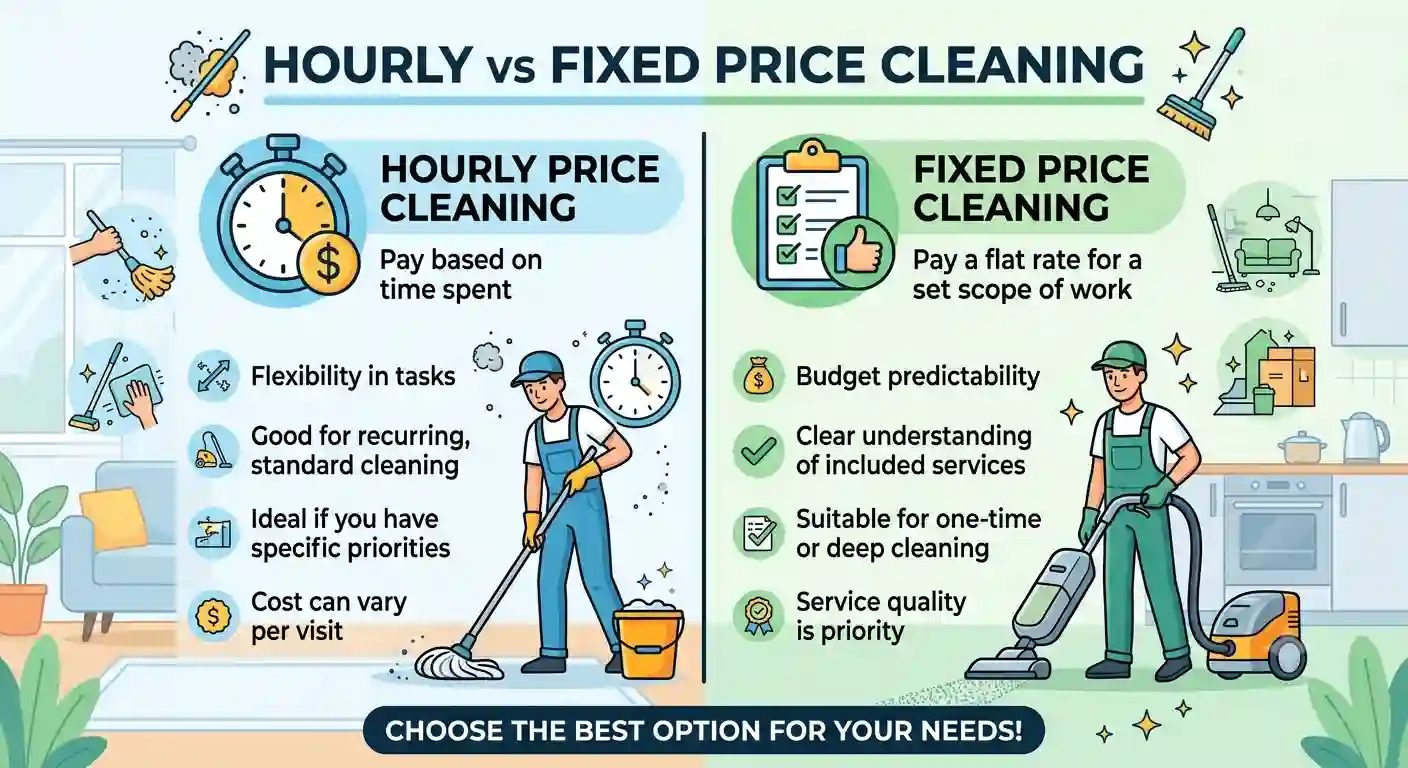
So how do cleaners charge? Most UK cleaners and companies charge one of two ways. Hourly rate cleaning charges for every hour (or part-hour) a cleaner is on-site, with the final bill depending on how long the job takes. It is the most common model for regular domestic cleaning, largely because ongoing weekly or fortnightly visits are predictable enough that both sides know roughly what to expect.
Fixed price cleaning — sometimes called flat-rate pricing — is agreed in advance for a specific scope of work, such as a two-bedroom flat or an end-of-tenancy clean of a particular size. The customer pays that amount regardless of whether the job takes two hours or four. Fixed pricing is most common for one-off jobs like deep cleans, move-out cleans, or larger commercial contracts, where the company has enough experience to estimate accurately.
The hybrid approach most companies actually use
Most reputable UK providers won't force customers into one model. Many quote an hourly rate as a starting benchmark, then confirm a fixed monthly or per-visit fee after an initial assessment of the home — effectively blending the two approaches so customers get the predictability of a fixed price built on the honesty of an hourly estimate.
What does UK cleaning actually cost in 2026?
UK domestic cleaning costs vary by model, provider type, and location. The average UK hourly rate for domestic cleaning falls somewhere between £14 and £30. Independent cleaners are typically cheaper — around £12 to £20 an hour — while agencies charge more, generally £14 to £26, partly to cover insurance, vetting, and admin overheads. London sits above the national average across the board, often by 25% to 35%, with agency rates commonly landing around £22 to £26 an hour. For full-day jobs, UK cleaners' day rates average around £149.
Fixed-price jobs vary enormously depending on scope. A standard fixed-price domestic clean for a two-bedroom home might run £50 to £90 per visit. A full deep clean or fixed-price end of tenancy cleaning, priced as a job rather than by the hour, typically costs £150 to £450 depending on property size and condition.
| Pricing model | Typical UK rate | Best suited to |
|---|---|---|
| Hourly (independent) | £12–£20/hour | Regular domestic cleaning, flexible households |
| Hourly (agency) | £14–£26/hour | Vetted, insured regular cleaning |
| Fixed price (standard clean) | £50–£90/visit | Predictable, recurring visits |
| Fixed price (deep/end-of-tenancy) | £150–£450/job | One-off, well-defined scope jobs |
Whichever model you choose, extras can quietly add to the bill. Specialist carpet cleaning is usually charged separately, at around £25–£55 per room. Upholstery cleaning — such as a sofa — often adds roughly £60 on top. Homes with pets frequently cost more, simply because pet hair and dander take longer to deal with properly. A detailed quote should spell all of this out before committing to either pricing structure.
What are the advantages of hourly rate cleaning?
Hourly pricing protects both sides from unpredictability. If a cleaner arrives and discovers the job is more complicated than expected — perhaps a kitchen that's been neglected for months, or a bathroom with stubborn limescale — they are not penalised for spending the time needed to do it properly. That matters for jobs that are genuinely hard to estimate in advance, such as post-renovation cleanups or a first deep clean of a home that hasn't seen a professional in years.
Hourly pricing also tends to suit newer cleaning businesses or freelancers who haven't yet built up the experience to accurately quote fixed prices. Rather than risk underquoting and working at a loss, they charge for the time actually spent — which keeps things fair for them and transparent for the customer, provided the hours are tracked honestly.
The obvious downside is uncertainty for the customer. Not knowing the final bill before work begins makes budgeting harder, and it's reasonable to wonder whether a cleaner might work more slowly than necessary when paid by the clock. That suspicion isn't always fair — most cleaners have no interest in dragging out a job when they could be earning from their next client — but it's a real psychological friction that fixed pricing avoids entirely.
Hourly pricing is better suited for: one-off or unpredictable jobs, first deep cleans, post-renovation cleanups, or any job where neither side can honestly estimate the scope in advance.
What are the advantages of fixed price cleaning?
Fixed pricing flips the incentive structure. Once a flat-rate price is agreed, the cleaner effectively earns more per hour by working efficiently — finishing early doesn't reduce what they're paid. For the customer, the appeal is straightforward: you know exactly what you're spending before anyone sets foot in your home, which makes it far easier to budget, particularly when comparing quotes from several companies.
This model works best when the scope of the job is well understood by both sides. A regular fortnightly clean of a property the cleaner already knows well is a strong candidate — there's little ambiguity about what needs doing, so a fixed monthly fee benefits everyone. The same applies to a standard end-of-tenancy job, where experienced companies — including those handling end of tenancy cleaning in London at volume — have priced hundreds of similar properties and know roughly how long a typical three-bed house takes.
Where fixed pricing runs into trouble is on jobs that turn out to be more demanding than anticipated. If a flat had gone longer without cleaning than the customer indicated, or a supposedly standard clean uncovers mould behind a wardrobe that needs proper treatment, a fixed fee agreed on the wrong assumptions either eats into the cleaner's earnings — which can lead to a rushed, lower-quality job — or triggers an awkward renegotiation partway through.
Fixed pricing is better suited for: regular recurring cleans, well-understood one-off jobs such as end-of-tenancy cleans, or any job where an experienced company can accurately scope the work in advance.
Hourly vs fixed price cleaning: which should you choose?
The right choice depends on the nature of the job, not whichever model sounds cheaper on paper.
Choose fixed pricing if you're booking a regular weekly or fortnightly clean of a home the cleaner will get to know over time. Once the first visit or two has established a realistic scope, fixed pricing offers budget certainty without penalising an efficient cleaner.
Choose hourly pricing if you're booking something less predictable — a one-off deep clean of a neglected property, a post-building-work clear-up, or anything where the scope is genuinely hard to assess in advance. Hourly pricing protects you from a rushed job dictated by an unrealistic flat fee, and protects the cleaner from unpaid hours on a bigger-than-quoted job. Whether to book a single visit or a standing arrangement is a separate decision — our guide to a one-off clean or a recurring cleaning plan covers that side of it.
There's also a simple practical test worth applying: ask for a written breakdown either way. A good fixed-price quote should specify exactly what's included, what counts as an extra, and what happens if the job turns out to be more involved than expected. A good hourly quote should give a realistic time estimate upfront, based on the home's size and condition, so the final bill isn't a complete surprise. Vague quotes on either model are the real warning sign — not the pricing structure itself.
Questions to ask before you book
Whichever model a company offers, a few questions will reveal how transparent they're likely to be in practice.
- On fixed pricing: What happens if the job takes longer than expected — will the company absorb it, or will you be asked for more money partway through?
- On hourly pricing: Can they give a realistic estimate based on similar properties, and is there a cap beyond which they'd check with you before continuing?
- On supplies: Are cleaning products and equipment included in the price? Some companies add £2 to £6 an hour if they bring their own products.
- On minimum charges: Do they apply a minimum call-out fee? This can make a quick one-off task disproportionately expensive under either model.
- On cancellations: What's the policy if you need to cancel or reschedule at short notice? Late cancellation fees are common and vary significantly between providers.
A company that's upfront about all of this from the start — without you having to dig for it — is generally a good sign of how they'll handle other awkward conversations down the line.
Frequently Asked Questions
Is hourly or fixed price cleaning cheaper overall?
It depends on the job. Fixed pricing tends to work out cheaper for straightforward, predictable cleans, since experienced cleaners price in efficiency. Hourly pricing can end up cheaper for smaller or lighter jobs, but riskier for anything that turns out more complicated than expected.
Can a cleaning company switch between pricing models?
Yes, and many do. It's common for a company to price an initial deep clean by the hour, then move customers onto a fixed monthly rate for ongoing visits once the property and its typical cleaning time are established.
What hidden costs should I check for regardless of pricing model?
Ask about minimum call-out fees, whether cleaning supplies are included, and whether specialist tasks like carpets, upholstery, or oven cleaning are charged separately. These extras apply under both hourly and fixed pricing.
Do commercial cleaning contracts use the same models as domestic cleaning?
Broadly yes, though commercial contracts more often use fixed monthly pricing based on square footage, since office and retail spaces tend to have more predictable, repeatable cleaning needs than private homes.
How do I know if a cleaning quote is fair?
Compare at least two or three quotes using the same scope of work. For hourly quotes, ask for an estimated time range based on your property size. For fixed-price quotes, ask for an itemised breakdown. Unusually low quotes — particularly on fixed-price jobs — can indicate corners will be cut if the job takes longer than expected.
What's the difference between a deep clean and a standard clean in terms of pricing?
A deep clean covers areas a standard maintenance clean doesn't — inside appliances, behind furniture, and hard-to-reach spots — so it almost always costs more, whether quoted hourly or fixed, and typically takes two to three times as long as a standard visit.