
Deep Cleaning vs Regular Cleaning: What's the Difference?
In short: regular cleaning maintains a tidy home through frequent, surface-level tasks like hoovering and wiping down counters. Deep cleaning goes further — tackling built-up grime, hidden bacteria, and overlooked areas like inside appliances, behind furniture, and grout lines. Most homes benefit from regular cleaning weekly and a deep clean every three to six months.
You've tidied the kitchen, run the hoover around, and wiped down the bathroom. The house looks clean. But flip over a sofa cushion, peer behind the oven, or shine a light into the extractor fan grille, and the story changes quickly.
This is the gap between regular cleaning and deep cleaning — and understanding it can save you time, money, and more than a few unpleasant surprises. Whether you're booking a professional cleaning service for the first time, considering a one-off deep clean, or trying to work out why your home still doesn't feel truly fresh after a tidy, this guide breaks down exactly what each service covers, how long each takes, what you can expect to pay, and how to decide which one your home actually needs right now.
What does regular cleaning include?
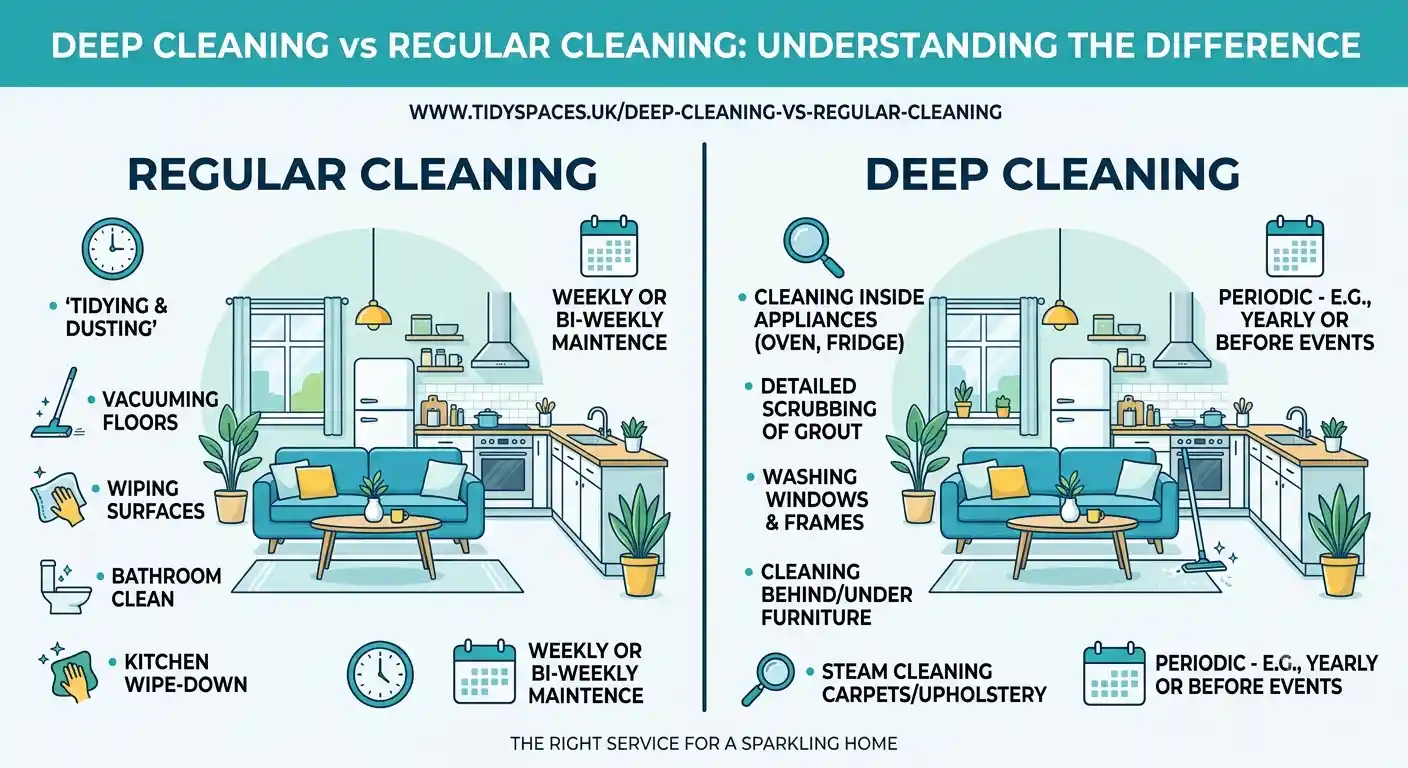
Regular cleaning — sometimes called a maintenance clean or routine clean — is designed to keep a tidy home tidy. It's the kind of cleaning most people do weekly or fortnightly, either themselves or with the help of a professional cleaner.
A standard regular clean typically covers:
- Kitchen: Wiping down surfaces and hob, cleaning the sink, and mopping the floor
- Bathrooms: Sanitising the toilet, sink, and shower or bath; wiping mirrors
- Living areas: Dusting accessible surfaces, hoovering carpets and rugs, mopping hard floors
- Bedrooms: Making beds, dusting surfaces, hoovering
- General: Emptying bins, tidying clutter, spot-cleaning visible marks
Regular cleaning does not include moving furniture, cleaning inside appliances, descaling taps, or scrubbing grout. It assumes a home is already reasonably clean and just needs upkeep.
Duration: A regular professional clean typically takes 1.5 to 3 hours, depending on the size of the property.
What does deep cleaning include?
Deep cleaning is a thorough, top-to-bottom clean and sanitisation of the entire home. It targets the areas that regular cleaning misses — built-up limescale, grease, bacteria, dust accumulation in hard-to-reach places, and general wear that compounds over time.
A professional deep clean typically includes everything in a regular clean, plus:
- Kitchen: Cleaning inside the oven, microwave, and fridge; degreasing extractor fans and hob surrounds; descaling the sink and taps
- Bathrooms: Scrubbing and descaling tiles and grout; cleaning behind the toilet; removing limescale from showerheads and taps
- Living areas: Cleaning skirting boards, light switches, and door frames; wiping down window sills and interior window frames; moving furniture to hoover and mop underneath
- Bedrooms: Cleaning inside wardrobes; wiping down headboards; dusting light fittings and ceiling corners
- General: Washing bins, cleaning inside kitchen cupboards, removing cobwebs from high corners
Duration: A professional deep clean typically takes 4 to 8 hours, depending on the size and current condition of the property.
Regular cleaning vs deep cleaning: a side-by-side comparison
| What's covered | Regular cleaning | Deep cleaning |
|---|---|---|
| Purpose | Maintain cleanliness | Remove built-up dirt and grime |
| Frequency | Weekly or fortnightly | Every 3–6 months |
| Duration | 1.5–3 hours | 4–8 hours |
| Relative cost | Standard rate | Approx. 1.5–2x regular clean |
| Inside appliances | No | Yes |
| Grout and tile scrubbing | No | Yes |
| Behind and under furniture | No | Yes |
| Skirting boards and door frames | No | Yes |
| Descaling taps and showerheads | No | Yes |
| Carpet shampooing and upholstery | No | Available as an add-on |
| Suitable for move-in/move-out | No | Yes |
How much does deep cleaning cost in the UK?
A professional deep clean in the UK typically costs between £95 and £550, depending on property size and condition — roughly 1.5 to 2 times the price of a regular clean for the same home. Hourly rates for vetted, insured cleaners generally sit around £15–£20 outside the capital and £20–£35 in London.
| Property size | Regular clean (indicative) | Deep clean (indicative) |
|---|---|---|
| 1-bedroom flat | £40–£70 | £95–£150 |
| 2-bedroom home | £55–£90 | £120–£180 |
| 3-bedroom home | £70–£110 | £150–£300 |
| 4+ bedroom home | £90–£140 | £300–£550+ |
These figures are indicative — the final price of a deep clean depends on:
- Property size — a one-bedroom flat will cost considerably less than a five-bedroom house
- Current condition — homes that haven't been deep cleaned recently, or that have significant limescale or grease build-up, will take longer
- Specific add-ons — inside-oven cleaning, fridge cleaning, and upholstery cleaning are sometimes priced separately
The best way to get an accurate price is to book a free consultation so a professional can assess your home's specific needs before quoting.
How often should you deep clean your home?
Most households need a deep clean every three to six months, with regular cleaning in between. Your ideal frequency depends on how your home is used:
- Every 8–12 weeks: High-traffic homes — families with young children, pets, or allergy sufferers who need dust mites, pet dander, and mould spores kept down
- Every 3–6 months: Most households that keep up regular weekly or fortnightly cleaning — the sweet spot for the majority of homes
- Every 6–12 months: Small, tidy households of one or two people with no pets and consistent maintenance cleaning
A few situations call for a one-off deep clean regardless of your usual schedule:
- Move-ins and move-outs — a deep clean before or after a tenancy is strongly recommended, and often required by letting agreements. See our end of tenancy cleaning service for tailored support
- Post-renovation — construction dust penetrates everywhere; an after builders clean is essential before settling back in
- Seasonal resets — many households schedule deep cleans in spring and autumn as part of a seasonal routine
If you maintain regular cleaning between deep cleans, the deep clean itself will be quicker and less intensive — and therefore less expensive.
Deep clean, end of tenancy clean, or sparkle clean?
Deep cleaning is often confused with two related services — but each is built for a different situation:
- Deep clean: A top-to-bottom reset of a lived-in home. Furniture stays in place (but gets cleaned behind and beneath), and the focus is on built-up grime, limescale, and hygiene
- End of tenancy clean: Carried out on an empty or near-empty property to an agency checklist standard, with the goal of securing a deposit return or preparing for new tenants — it includes inside cupboards, wardrobes, and appliances as standard
- Sparkle clean: A finishing clean for post-renovation or show-home presentation — every surface polished and streak-free, ready for viewings or handover day
If you're unsure which applies to your situation, describe it to us and we'll recommend the right one — no upselling, just the service that fits.
Which type of cleaning do you need?
Not sure which service is right for you? Work through this quick checklist.
Choose regular cleaning if:
- Your home is already reasonably clean and tidy
- You want to maintain cleanliness on a weekly or fortnightly basis
- You've had a professional deep clean recently
- You're looking for an ongoing cleaning arrangement
Choose deep cleaning if:
- You're moving into or out of a property
- Your home hasn't been professionally cleaned in six months or more
- There's visible limescale, grease build-up, or grime in hard-to-reach areas
- You've recently had building work, a party, or a period of illness in the home
- You're starting a regular cleaning arrangement and want a proper baseline first
Many professional cleaning services recommend starting with a one-off deep clean before transitioning to regular maintenance visits. This approach ensures the cleaner is maintaining a genuinely clean home — not working around built-up grime. If you're in the capital, our London deep cleaning team covers every borough — and for a closer look at how the process works city by city, see our deep cleaning services in London guide.
Start with the clean your home actually needs
Regular cleaning keeps a home running smoothly. Deep cleaning resets it. Both serve a purpose — the key is knowing which one your home needs right now, and how the two work together over time.
If you're unsure where to start, TidySpaces offers a free, no-obligation consultation to assess your home and recommend the right service. There's no pressure and no guesswork — just clear, honest advice about what will make a genuine difference.
Frequently Asked Questions
What's the difference between a deep clean and a regular clean?
A regular clean maintains surface-level tidiness through tasks like hoovering, wiping surfaces, and sanitising bathrooms. A deep clean goes much further — targeting grout, limescale, inside appliances, and areas behind or beneath furniture. Deep cleans are more intensive, take longer, and cost more than routine maintenance cleans.
How long does a deep clean take compared to a regular clean?
A regular professional clean typically takes 1.5 to 3 hours, depending on property size. A deep clean usually takes 4 to 8 hours for the same property, because it covers a far greater number of areas and involves more labour-intensive tasks like oven cleaning and grout scrubbing.
Is a deep clean necessary before starting a regular cleaning service?
Not always, but it's strongly recommended. Starting with a deep clean gives your cleaner a proper baseline to maintain. Without it, a regular cleaner may spend time working around built-up grime rather than keeping an already-clean home fresh — which reduces the quality and efficiency of every future visit.
How much does a deep clean cost compared to a regular clean?
Deep cleaning typically costs 1.5 to 2 times more than a regular clean for the same property — in the UK that usually means £95–£350 for a deep clean depending on property size. The higher cost reflects the longer duration, greater effort, and specialist products required. Property size and current condition are the biggest factors influencing the final price.
Is deep cleaning worth it?
Yes, if your home hasn't been professionally cleaned in three months or more. A deep clean removes build-up that regular cleaning can't reach — inside appliances, grout, limescale, and behind furniture — and once it's done, every regular clean afterwards is faster and more effective, so the investment pays for itself over time.
Can regular cleaning replace deep cleaning?
No. Regular cleaning maintains cleanliness but never tackles hidden build-up — limescale, grease, and dust in hard-to-reach areas accumulate regardless of how often surfaces are wiped. The two work together: regular cleaning slows the build-up, and a periodic deep clean removes it.
What's the difference between a deep clean and an end of tenancy clean?
A deep clean resets a lived-in home; an end of tenancy clean is done on an empty property to a letting-agency checklist standard, including inside all cupboards, wardrobes, and appliances. If you're moving out and want your deposit back, book an end of tenancy clean rather than a standard deep clean.
What's the best way to prepare for a professional deep clean?
Decluttering before your cleaner arrives makes the biggest difference — clear kitchen worktops, empty bathroom cabinets, and pick items up off the floor. This lets the team focus on actual cleaning rather than tidying, so you get the most value from the time booked. No need to move heavy furniture yourself — that's part of what the deep clean covers.