

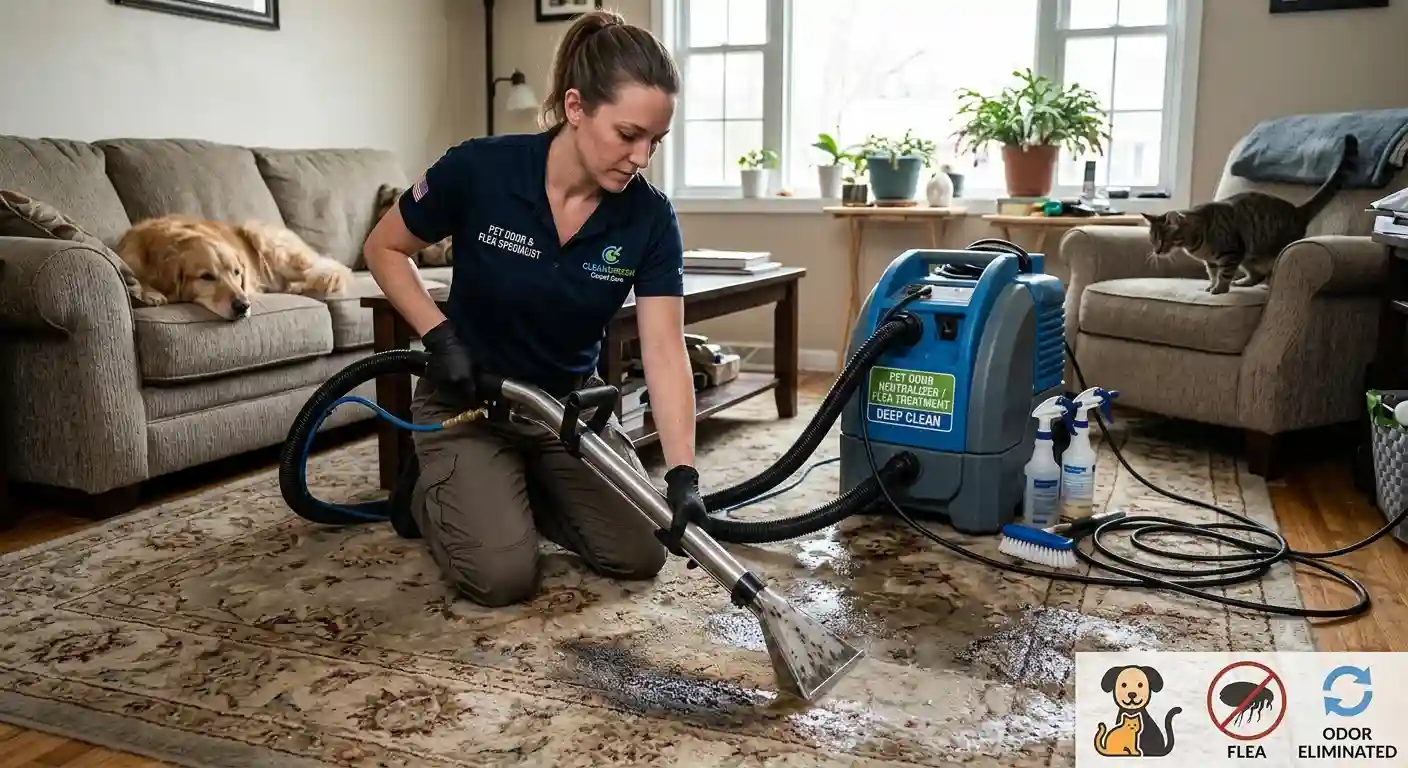
Will Professional Carpet Cleaning Remove Pet Odours, Urine Smell or Fleas?
Professional carpet cleaning removes most surface pet odours effectively, kills adult fleas on contact, and eliminates the everyday build-up of fur and dander that accumulates in any home with animals. However, deeply set urine smells and active flea infestations require more than a single carpet clean to fully resolve. Understanding why — before you book — helps you set realistic expectations and get the right treatment first time.
Anyone who's lived with a dog or cat for long enough knows the moment: you walk into a room and catch a whiff of something that shouldn't be there. Maybe it's an old accident nobody quite dealt with properly, maybe it's just the general, hard-to-pin-down smell that builds up in a home with animals in it. The instinct is to book a professional carpet clean and assume the problem's solved. Mostly, that instinct is right. But "mostly" is doing some work in that sentence, and it's worth understanding exactly what a professional clean can and can't fix before you book one expecting a miracle.
Before You Book: The Essentials
- Professional carpet cleaning removes most surface pet odours effectively, but fresh accidents respond far better than urine that's had months to set in.
- If urine has soaked through to the underlay or subfloor, surface cleaning alone won't fully clear the smell — that layer may need replacing.
- Steam cleaning kills adult fleas on contact — temperatures above 50°C are lethal to them, and steam cleaning typically exceeds 60°C at the carpet surface — but eggs and larvae often survive and need separate treatment.
- A genuine flea infestation needs carpet cleaning combined with pet treatment and, often, a residual insecticide — not carpet cleaning alone.
Will one clean fix it? The quick answer by problem
| Problem | Will one professional clean fix it? | What else is needed |
|---|---|---|
| General pet smell (fur, dander) | Yes, usually | Nothing — regular cleaning maintains it |
| Fresh accident (days old) | Yes, with enzymatic treatment | Nothing in most cases |
| Old, set-in urine smell | Often, but not guaranteed | Enzymatic pre-treatment; possibly repeat visits |
| Urine soaked into underlay/subfloor | No — the source is below the carpet | Underlay replacement, sometimes subfloor sealing |
| A few fleas spotted | Largely — kills adults on contact | Pet flea treatment to stop reintroduction |
| Active flea infestation | No — eggs and larvae survive | Pet treatment + residual insecticide + follow-up vacuuming |
Why pet smells are harder to shift than they look
Pet urine odour is difficult to remove from carpets because urine doesn't stay at the surface. It travels down through the carpet pile, through the backing, and often into the underlay and subfloor beneath — meaning the smell you're dealing with may originate well below what any surface clean can reach.
A dog or cat accident on a carpet isn't just a stain sitting on the surface. Urine is liquid, and liquid follows gravity and capillary action down through the carpet pile, through the backing, and often into the underlay and even the subfloor beneath it. What you can see and smell from standing height is often only the top layer of a problem that goes considerably deeper.
This matters because it explains why some pet odours vanish completely after a single professional visit while others linger stubbornly no matter how thoroughly the surface is cleaned. The carpet you can see is only part of the story — what's happened underneath, and how long ago, tends to determine the outcome more than anything the cleaning technician does on the day.
What professional carpet cleaning actually does well
Hot water extraction carpet cleaning — the method most reputable UK cleaners use — is genuinely effective against pet odours in the majority of cases. It works by injecting hot water and cleaning solution deep into the fibres under pressure, then extracting it immediately along with the dirt, bacteria, and odour-causing residue it's loosened. For general pet smell — the everyday build-up from fur, dander, and normal pet activity rather than a specific accident — this method reaches soil that a domestic vacuum or a bottle of carpet shampoo simply can't touch.
Good professional cleaners also use enzymatic treatments specifically formulated for pet stain removal, rather than relying on standard cleaning solution alone. These work differently to ordinary detergent: enzymes actually break down the proteins and bacteria in urine that produce the smell, rather than just masking it with fragrance or lifting surface residue. One detail worth knowing: enzymes need dwell time to work and are deactivated by high heat — which is why proper pre-treatment happens before the hot extraction pass, not at the same time as it. Used properly, and on a problem that hasn't had months to embed itself, this combination resolves the vast majority of pet odour complaints in a single visit.
Why some urine smells don't fully disappear after cleaning
Professional carpet cleaning doesn't guarantee complete odour removal in every case. Two factors — timing and depth of penetration — determine outcomes more than anything else.
Timing matters more than almost anything else. A fresh accident, treated within hours or a day or two, responds well because the urine hasn't had time to crystallise and bond to the carpet fibres. An old stain — the kind that's been there for months, possibly through several seasons of humidity changes — behaves very differently. Urine salts crystallise as they dry, and those crystals can reactivate and release odour whenever humidity rises. This is part of why an old pet smell sometimes seems to "come back" on a damp day even after a clean.
Depth of penetration is the other major factor. If urine has soaked through the carpet and its backing into the underlay, or further still into a wooden or concrete subfloor, surface-level cleaning genuinely cannot reach it. The carpet itself might come up smelling perfectly fresh, only for the odour to reassert itself within days — because the actual source was never in the carpet to begin with by that point; it was underneath it. In cases like this, a professional cleaner worth their reputation will tell you honestly that full resolution may require replacing the affected underlay, and sometimes sealing the subfloor itself, rather than promising a clean will sort it when it structurally can't.
Carpet fibre type plays a smaller but real role too. Wool carpets tend to hold onto odours more stubbornly than synthetic fibres like nylon or polypropylene, partly because wool is naturally more absorbent. This doesn't make wool carpets uncleanable, but it can mean an extra treatment or a longer drying time is needed to fully shift a deep-set smell.
What to do if you're dealing with an old pet smell
For older, set-in pet odours, ask the cleaning company directly whether they use enzymatic pre-treatment specifically for pet odours — this makes a measurable difference compared to standard solution. Also ask them to assess, before starting, whether the smell seems confined to the carpet or likely to have reached the underlay.
A good technician can often tell from the extent and age of visible staining, and being upfront about this before the job starts saves you paying for a clean that was never going to fully solve a problem sitting underneath the carpet rather than in it. In genuinely severe or long-standing cases, replacing the underlay in the affected area alongside the carpet clean is often the only route to a completely fresh-smelling room. And if you're tackling a fresh accident yourself before the professionals arrive, our guide to removing pet stains from carpet covers the right first-response steps — and the common DIY mistakes that make stains harder to treat later.
Does professional carpet cleaning kill fleas?
Professional carpet cleaning kills adult fleas but does not, on its own, fully resolve a flea infestation. Temperatures above 50°C are lethal to adult fleas, and steam cleaning typically exceeds 60°C at the carpet surface — sufficient to kill them on contact. But flea eggs and larvae sit deeper in carpet fibres and require higher, more sustained heat to be neutralised.
The problem is what carpet cleaning doesn't reach. Flea eggs and larvae are considerably more resilient than adult fleas, and they tend to shelter deeper in carpet fibres, in cracks in flooring, and in soft furnishings well beyond where a carpet cleaner's pass will penetrate. A single professional clean will meaningfully reduce the visible adult flea population and general surface activity, but it very rarely resolves a genuine infestation on its own.
How to deal with a real flea infestation properly
A genuine flea infestation requires a coordinated approach: professional carpet cleaning, direct pet treatment, and a residual insecticide targeting eggs and larvae. No single step alone is sufficient.
If you're dealing with more than the odd flea — genuine bites, fleas visible on pets or in bedding, or that unmistakable sense of an active infestation — carpet cleaning needs to be one part of this coordinated approach rather than the whole solution. Treating your pet directly, through a vet-recommended flea treatment, is essential, since an untreated pet will simply reintroduce fleas to a freshly cleaned carpet within days.
Most pest control professionals recommend a residual insecticide treatment for the home itself, specifically targeting eggs and larvae in carpets, skirting boards, and soft furnishings that heat treatment alone won't fully eliminate. Combining professional carpet cleaning with this kind of targeted treatment — plus consistent vacuuming in the weeks that follow to physically remove eggs as they're disturbed — delivers dramatically better results than any single step attempted in isolation.
Timing the different treatments sensibly also makes a real difference. Vacuuming thoroughly before a professional clean helps remove loose eggs and debris that might otherwise just get pushed further into the pile. Treating pets for fleas a few days before the carpet clean, rather than on the same day, gives the treatment time to start working and reduces the chance of fleas jumping straight back onto a freshly cleaned carpet from an untreated animal.
It's worth being wary of any company that claims a single carpet clean will fully resolve an active infestation on its own. Ask upfront what their actual plan is for eggs and larvae, not just the adult fleas visible on the day.
Getting the most out of a professional visit
A few consistent practices improve the outcome of professional carpet cleaning for pet odours and fleas, regardless of which company you book — and wherever you are; our carpet cleaning in Birmingham team fields exactly the same pet questions as our London crews.
Point out specific problem areas before the clean starts, rather than assuming the technician will find them. You know your home better than someone walking in for the first time, and a specific accident from eighteen months ago in the corner of the spare room is easy to miss if nobody mentions it.
Ask what pre-treatment they use for pet-related odours specifically, and don't be shy about asking how they'd handle a case where the smell has reached the underlay. A company confident in its process will answer both questions clearly rather than giving you vague reassurance that everything will come out fine regardless.
Be realistic about timelines. A carpet can look and smell completely fresh immediately after a clean, but it needs proper drying time, and judging the final result on the same day the technician leaves isn't a fair test. Give it a day or two — particularly through any change in humidity — before deciding whether the result has genuinely held.
It's also sensible to keep pets away from a freshly cleaned carpet until it's properly dry, both for the carpet's sake and because damp carpet fibres can be more attractive to any surviving fleas or larvae looking for a place to shelter. Most professional cleaners will give you a realistic drying window on the day, and it's worth sticking to it rather than letting an excitable dog straight back onto a carpet that's still damp underneath.
Frequently Asked Questions
Will one professional clean fully remove old dog urine smell?
It depends on how deep the urine has penetrated. Fresh or moderately old stains confined to the carpet respond well to a single professional clean with enzymatic treatment. Urine that's reached the underlay or subfloor often requires that layer to be replaced for the smell to fully disappear — surface cleaning cannot reach the source once it has migrated below the carpet.
Can carpet cleaning alone get rid of a flea infestation?
No. Professional steam cleaning kills adult fleas on contact but rarely reaches eggs and larvae effectively. A genuine infestation needs carpet cleaning combined with direct pet treatment and, in most cases, a residual insecticide targeting the home environment to fully resolve.
Why does pet odour sometimes come back after professional cleaning?
Urine salts crystallise as they dry and can reactivate, releasing odour again when humidity rises. This is common with older, set-in stains and usually indicates the smell has penetrated beyond what surface cleaning reached — often into the underlay or subfloor.
Is it worth asking a cleaning company about their pet-specific treatment before booking?
Yes. Standard cleaning solution and enzymatic pet-odour treatment perform very differently against urine smells. A company using enzymatic pre-treatment as standard practice is considerably more likely to fully resolve the problem in one visit.
How long after a professional carpet clean will the smell be gone?
For surface-level pet odours, the result is usually apparent once the carpet is fully dry — typically within 24 to 48 hours. Judging results immediately after the clean, while the carpet is still damp, is not a reliable indicator. If an odour persists after the carpet has fully dried, it is likely the source has penetrated below the carpet surface.
Is wool carpet harder to clean for pet odours than synthetic carpet?
Yes, to a degree. Wool is naturally more absorbent than synthetic fibres such as nylon or polypropylene, which means it can hold onto odours more tenaciously. Wool carpets are not uncleanable, but may require additional treatment passes or longer drying time to fully shift a deep-set pet smell.