

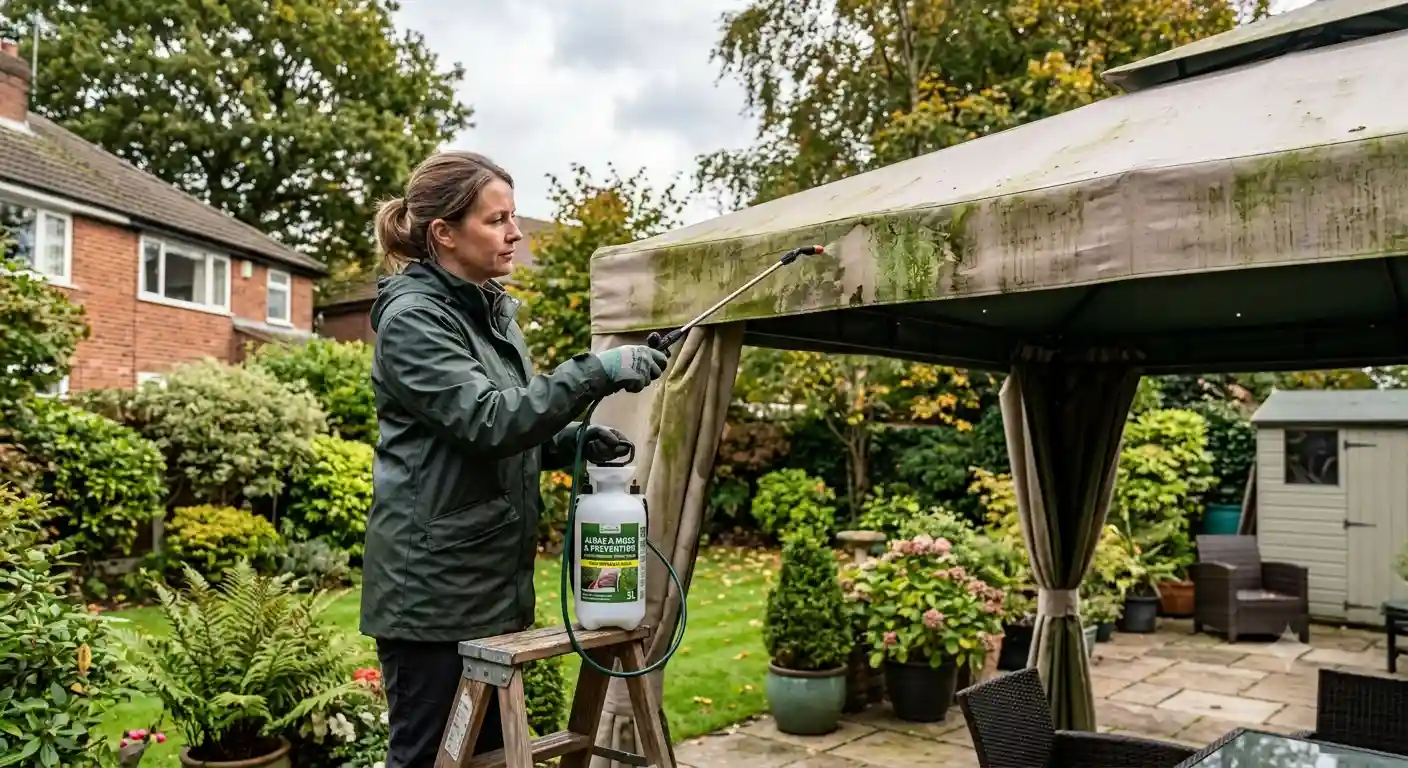
How weather affects canopy dirt, mould and algae build-up in the UK
Canopy mould, algae and staining in the UK are primarily driven by the country's persistently damp, overcast climate, not by poor maintenance alone. Frequent light rain, extended cloudy periods, and mild temperatures that rarely dry surfaces quickly create near-ideal conditions for organic growth across a significant portion of the year.
The counterintuitive part is this: it's not the sunny days that ruin a fabric canopy. It's the grey, damp, forgettable weeks in between, the ones that never make it into anyone's memory of a British summer, that quietly do the most damage. By the time algae streaks or dark mould patches are actually visible, the conditions that caused them have usually been building for months, largely unnoticed.
What's Actually Driving the Build-Up
- Mould, mildew and algae thrive on moisture, shade, and slow drying, three conditions the UK climate delivers for a significant part of the year.
- Fabric canopies typically have a functional lifespan of around 5 to 10 years, and untreated mould and algae can shorten that considerably by working into the fibres themselves.
- A north-facing or heavily shaded canopy develops mould and algae considerably faster than a south-facing one, purely because of how differently sunlight and airflow reach each position.
- Most outdoor canopies benefit from a professional clean once or twice a year, timed around the start and end of the season they're used most, though shaded or north-facing installations may need attention more often.
Why does the UK climate cause canopy mould and algae
Canopy mould and algae in the UK persist because the climate consistently delivers the three conditions these organisms need most: moisture, shade, and slow drying. A huge share of the UK's actual weather pattern, frequent light rain, extended overcast periods, and relatively mild temperatures that rarely dry things out quickly, creates almost exactly the environment these organisms need to establish and spread.
This matters because it reframes the whole problem. A fabric canopy isn't getting dirty through some avoidable failure of care, it's sitting permanently in a climate that's genuinely conducive to organic growth for a significant portion of the year. Understanding this shifts the useful question from "how do I stop this happening" to "how do I manage it realistically, given what the weather's actually doing."
What specific problems does British weather cause on canopies
The most commonly reported problems on outdoor canopies in the UK, algae build-up, discolouration, staining, mould, and bird mess, each have a slightly different relationship with the weather patterns that cause them.
- Algae build-up specifically favours prolonged dampness combined with limited direct sunlight, exactly the condition a north-facing or heavily shaded canopy experiences through much of a typical British autumn and winter.
- Discolouration and staining often develop more gradually. Organic debris and airborne particulates settle onto fabric during wetter periods and never fully dry out or wash away before the next damp spell arrives, producing a slow, cumulative darkening that's easy to dismiss until it becomes deeply embedded.
- Mould and mildew follow a similar pattern to algae, favouring shaded surfaces where moisture lingers longest after rain, and are often what's responsible for that "just a bit dingy" appearance a canopy develops over autumn and winter, long before any obvious growth becomes visible.
Why are fabric canopies particularly vulnerable to mould damage
Fabric canopies are more vulnerable than hard surfaces because they absorb and retain organic material in ways rigid structures do not, and that absorbed material can cause genuinely irreversible damage if left untreated for long enough. Fabric canopies, including retractable awnings and sun shades, accumulate dirt, bird droppings, algae and general organic debris over time.
This is a meaningfully different situation from a hard surface like a canopy frame or a patio, which can typically be restored to something close to its original condition even after significant neglect. Fabric absorbs and holds organic material in a way rigid materials don't. Prolonged exposure allows mould and algae to actually work into the fibres themselves, weakening and staining the material in ways that professional cleaning can improve but not always fully reverse. With a typical fabric canopy lifespan of around 5 to 10 years, unaddressed mould and algae can meaningfully shorten that window, turning what should be a long-term investment into a much shorter one.
What is actually growing on a fabric canopy
Much of what appears as early staining or dinginess on a fabric canopy is caused by microscopic algae and fungi, organisms that affect colour and appearance well before any visible growth becomes obvious. This is precisely why a canopy can look "just a bit dingy" rather than obviously mouldy for a long period, even though the underlying biological process causing that dinginess has already been active for weeks or months.
Professional cleaning services specifically target this micro-organism layer, not just the visible surface debris, which is a meaningful difference from a simple hose-down or surface wipe that only addresses what's immediately visible.
Why does canopy mould keep coming back after cleaning
Canopy mould and algae return quickly after basic cleaning because most surface-level approaches remove visible growth without addressing the underlying biological layer that caused it. A quick surface clean addresses what's visible at the time, but it doesn't necessarily deal with the underlying micro-organism layer that caused the problem in the first place. This is exactly why staining and algae so often reappear within weeks of a basic DIY clean.
This is where specialised cleaning products and professional treatments genuinely earn their cost over a basic hose-and-brush approach. Products specifically formulated for outdoor mould, mildew and algae removal target the organism itself. Some create a protective barrier afterwards that actively resists regrowth for up to six months, a meaningfully different outcome from a clean that simply removes what's currently visible and leaves the underlying conditions completely unchanged.
The UK seasonal pattern worth planning around
Rather than treating canopy maintenance as a one-off task whenever it starts looking obviously bad, it's genuinely more effective to think about it in relation to the UK's actual seasonal weather pattern. Late autumn through winter, when damp, shaded, low-sunlight conditions dominate for extended stretches, is when algae and mould get the strongest foothold, even if the visible evidence doesn't become obvious until much later.
Spring, as light levels and drying conditions improve, is often when existing growth becomes most visually apparent. Increased contrast and longer daylight hours make staining and discolouration harder to miss. This makes early spring a genuinely sensible point to assess and address whatever's built up over the preceding damp months, rather than waiting until a canopy looks obviously neglected in high summer.
Can canopy mould and algae prevention be permanent
No, nothing stops canopy mould and algae indefinitely in the UK climate, but the interval between necessary cleans can be meaningfully extended with the right approach. Fixing dripping or overflowing gutters and downpipes near a canopy removes a constant, concentrated source of dampness that would otherwise sit directly against the fabric or structure. Checking that surrounding paving falls away from the building rather than holding standing water prevents another common, easily overlooked source of persistent moisture right at ground level.
Practical steps that genuinely slow canopy build-up
Beyond fixing gutters and drainage, a few other habits meaningfully slow the rate of build-up between full cleans:
- Trim overhanging vegetation near the canopy. This reduces both the shade that encourages algae growth and the organic debris, leaves, pollen, sap, that regularly falls onto the surface and provides additional material for organisms to establish on.
- Brush off loose debris regularly, before it has a chance to become damp and embedded. Dry debris is far easier to remove than the same material once it's been through several wet-dry cycles and started to break down into the fabric.
- Apply a specialist protective treatment after a thorough professional clean. Some formulations create a surface barrier that resists biological regrowth for up to six months, not permanently, but meaningfully.
Does a canopy's orientation affect how quickly mould builds up
Yes, significantly. A north-facing or heavily shaded canopy will develop mould and algae considerably faster than a south-facing one, because of how differently sunlight and airflow reach each position. A canopy facing north, or one positioned beneath overhanging trees or close to a neighbouring building, receives considerably less direct sunlight than one facing south or west, and that difference translates directly into how quickly damp conditions dry out after rain.
| Orientation | Typical risk level | Suggested cleaning interval |
|---|---|---|
| South or west-facing, open position | Lower | Around once a year |
| North-facing or shaded by trees/buildings | Higher | Twice a year or more |
This is genuinely useful information when planning realistic maintenance intervals for a specific property, rather than applying a single generic schedule to every canopy regardless of its position.
Commercial canopies: additional pressures to consider
Business premises with shopfront or restaurant canopies face some additional considerations beyond what a typical domestic canopy deals with. Higher footfall areas often mean more airborne debris and pollution settling onto the fabric, and a canopy's appearance directly affects how a business presents itself to passing customers, making visible staining or mould a genuine reputational concern, not purely a maintenance issue.
Commercial settings also frequently involve larger, more complex canopy structures that are harder to inspect and clean without proper equipment and trained access. This is precisely why many businesses schedule professional attention on a fixed periodic contract rather than waiting until problems become visually obvious to customers and staff. If you run a business site in the capital, our London canopy care team can build this into a regular maintenance schedule.
When to book a professional canopy clean
Given how the UK climate works against permanent solutions, a sensible approach treats professional attention as a periodic, planned task rather than an emergency response to something that's already become visibly bad. Most outdoor canopies benefit from professional cleaning once or twice a year, ideally timed around the start and end of the season they're used most.
For canopies in particularly shaded or damp locations, north-facing installations, or those near dense trees or persistent damp spots, this interval genuinely needs to be shorter than for a canopy in a more open, sunnier position, since the underlying conditions driving growth are simply more favourable to algae and mould in the first location than the second. You can arrange a professional canopy assessment if yours is starting to show early signs of staining or dinginess, or see the rest of our outdoor cleaning services if you're planning a wider maintenance schedule.
Frequently asked questions
Why does my canopy grow mould even though I clean it regularly?
Regular surface cleaning often only removes visible debris, not the underlying micro-organism layer causing staining and discolouration. Without treatment specifically targeting algae and fungi at a biological level, regrowth within weeks is common, even after a seemingly thorough clean.
Is fabric canopy damage from mould and algae ever permanent?
It can be, if left long enough. Fabric absorbs organic material in a way hard surfaces don't, and prolonged neglect allows mould and algae to work into the fibres themselves, causing staining and weakening that professional cleaning can improve but not always fully reverse.
How long do protective treatments actually stop regrowth?
Some specialised treatments create a barrier that resists mould and algae regrowth for up to six months, though no treatment stops it indefinitely in the UK's damp, shaded climate conditions that consistently favour these organisms.
What's the single most effective way to slow canopy build-up between cleans?
Fixing dripping or overflowing gutters near the canopy and ensuring surrounding paving drains away from the structure rather than holding standing water. Both remove persistent, concentrated moisture sources that otherwise accelerate growth significantly.
How often should a canopy be professionally cleaned in the UK?
Most outdoor canopies benefit from professional cleaning once or twice a year, timed around the start and end of the season they're used most. A shaded, north-facing canopy near trees may need attention more than once a year, while a south-facing canopy in an open position may manage comfortably on an annual schedule. The key is to clean before fabric damage becomes irreversible, not after.
Does the type of canopy fabric affect how quickly mould develops?
Some fabrics are more resistant to biological growth than others, particularly those treated with mould-inhibiting finishes at the manufacturing stage. However, no fabric is immune to the UK's climate indefinitely, orientation, shade, and proximity to moisture sources have a more significant practical effect on build-up speed than fabric type alone.