
Airbnb Cleaning Checklist for Hosts: A Room-by-Room Turnover Guide
A thorough Airbnb cleaning checklist is one of the most effective tools a host can have. Guests forgive slow Wi-Fi or tricky parking, but a hair in the bathtub or a fridge that still smells of the last guest's leftovers will show up in your star rating within hours. Get the turnover clean right, consistently, and it becomes one of the quiet reasons guests keep booking you over the flat down the road.
This checklist pulls together what experienced UK hosts and Airbnb's own guidance actually recommend, room by room — whether you host on Airbnb or run a holiday let — so you've got something practical to work from rather than a vague "give it a once-over."
Why Airbnb turnovers deserve their own cleaning system
A turnover clean is not the same as cleaning your own home. Hosts are resetting a space to look untouched — for a guest who is paying to feel like the first person ever to stay there. That is a higher bar than most people hold their own houses to.
It also has to happen fast. Most UK hosts set checkout for 10am or 11am and check-in for 3pm or 4pm, leaving a window of four to six hours. A studio or one-bed typically takes 1.5 to 2 hours to turn around properly; a two-bedroom place needs closer to 2.5 to 3 hours; and anything with three bedrooms or more can run to 3 or 4 hours, especially if it is a full deep clean rather than a routine turnover.
Same-day changeovers with back-to-back guests are exactly when corners get cut and details get missed — which is precisely why working from a written checklist, rather than memory, matters so much.
What is Airbnb's five-step enhanced cleaning process?
Airbnb's five-step enhanced cleaning process was developed originally in response to the pandemic but remains a sound framework for any host. The five steps are: prepare the space and gather supplies; clean visible dirt and dust; sanitise high-touch surfaces; check your work against a room-by-room list; then reset the space with fresh linen and supplies. This structure maps neatly onto the checklist below.
The quick-reference turnover checklist
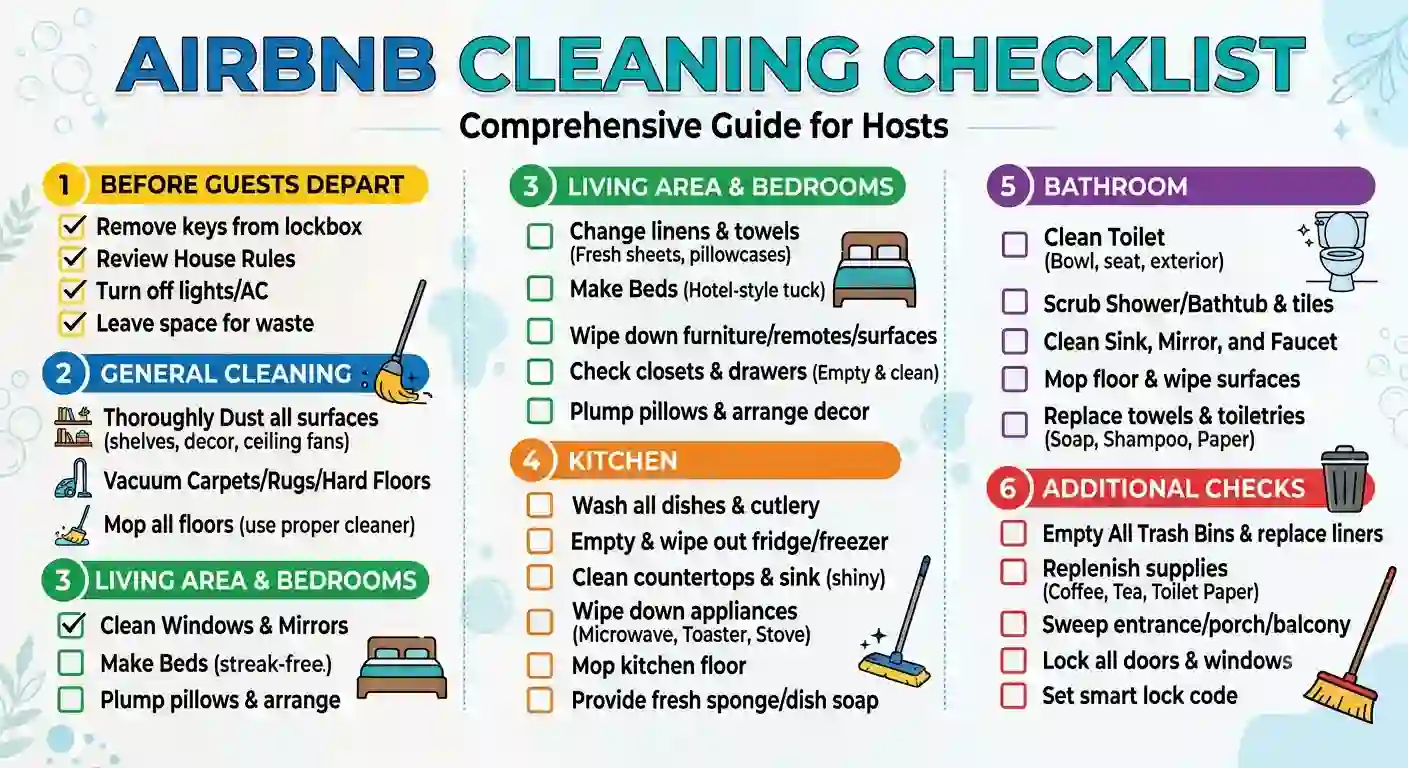
Here's the whole turnover at a glance — print it, laminate it, or hand it to your cleaner. The sections below expand on each room.
| Area | Key tasks every turnover |
|---|---|
| Prep | Ventilate, strip beds, start laundry, gather supplies |
| Kitchen | Worktops and hob, empty fridge, bins, sink and taps, small appliances |
| Bathroom | Toilet, shower/bath, sink, mirror, floor, fresh towels, refill toiletries |
| Bedrooms | Fresh linen, check under beds and in drawers, dust, hoover, open curtains |
| Living areas | Cushions and throws, hoover sofas, dust, test remotes, empty bins, mop |
| Entrance & outside | Door and doormat, lockbox check, bins out, outdoor furniture |
| Final checks | Alarms, window locks, heating set, restock consumables |
Before you start: prep and supplies
Walking into a property without everything you need is the single biggest time-waster in a turnover. Hosts who gather every product, cloth, bin bag, and set of linen before starting save a genuine 15 to 20 minutes per clean, simply by not making repeat trips to the car or the cupboard.
- Ventilate the property first — open windows to air the space while you work
- Strip all beds and gather used towels before doing anything else
- Start the laundry immediately — washing and drying take the longest of any task and can run in the background while you clean
- Lay out fresh linen, towels, toiletries, and welcome supplies within reach
- Bring disinfectant, glass cleaner, a hoover, mop, and enough cloths that you are not reusing a bathroom cloth in the kitchen
Restock these consumables every turnover, before you leave:
- Toilet rolls (at least two per bathroom, plus spares in view)
- Soap, shampoo, and washing-up liquid
- Bin liners in every bin
- Tea, coffee, sugar, and any welcome pack items
- Dishwasher tablets and a fresh sponge or cloth for guests
Kitchen cleaning checklist
The kitchen is where guests judge a property hardest, because it is where hygiene concerns are most visible.
- Wipe down every worktop, the hob, and the inside and outside of the microwave
- Empty the fridge completely and wipe the shelves — finding a half-eaten jar of pickle from three guests ago is one of the fastest ways to lose a five-star review
- Run the dishwasher, or hand-wash and put away anything left out
- Empty the bin and fit a fresh liner
- Polish the sink and taps — limescale build-up is one of the fastest ways a kitchen starts to look neglected, even when it is technically clean
- Descale the kettle, empty the toaster crumb tray, and clear old grounds from the coffee machine
Bathroom cleaning checklist
Bathrooms are unforgiving. Guests notice fingerprints on mirrors, hairs on the floor, and grime around the base of the toilet faster than almost anything else in a property — and those small details override everything else in their mind.
- Scrub the toilet inside and out, including the base and behind it
- Clean the shower or bath thoroughly, paying attention to grout and soap scum on glass screens
- Wipe down the sink and taps
- Polish the mirror
- Mop the floor last, so you are not walking back over a wet surface
- Replace towels and bath mats with fresh, laundered ones
- Refill soap, shampoo, and toilet roll
- Check cabinets and drawers for anything left behind by the previous guest
Bedroom cleaning checklist
Fresh linen is non-negotiable, and it needs to be properly laundered on a high heat — not just visually clean.
- Strip and remake every bed with freshly laundered linen
- Check under beds and behind headboards for anything left behind
- Dust surfaces, including skirting boards, lampshades, and picture frames — these tend to get skipped in a rushed clean
- Vacuum the floor, including under the bed where accessible
- Open curtains or blinds so the room looks bright and welcoming on arrival
- Check wardrobes and drawers for stray hangers, forgotten socks, or a phone charger left in a corner — it takes thirty seconds and saves an awkward message three days later
Living areas and general spaces
Living rooms accumulate the evidence of a stay fastest: cushions out of place, throws abandoned wherever they landed, remote controls migrated under the sofa.
- Plump and straighten cushions; fold throws neatly
- Vacuum sofas and rugs
- Dust surfaces, including TV screens, which show fingerprints and dust more obviously than almost anything else in a room
- Check remote controls work and have functioning batteries — a broken remote is a surprisingly common source of one-star complaints
- Empty bins throughout the property, not just in the kitchen
- Mop hard floors if they have had any foot traffic
Entrance and outside areas
First impressions start before the front door opens, and this is the area most turnover cleans skip entirely.
- Wipe down the front door and clean or shake out the doormat
- Check the lockbox or smart lock works and the code is set correctly for the next guest
- Make sure bins are out on the right collection day, or at least not overflowing by the entrance
- Give outdoor furniture a quick wipe in warmer months, and sweep leaves from steps or a shared porch
The details guests actually notice
Guests do not inspect a property the way a host might expect. They notice the things they touch, not necessarily the things that took the most effort to clean.
High-touch surfaces to prioritise: Door handles, light switches, remote controls, and tap handles are where fingers land constantly. These are the surfaces most worth disinfecting properly, rather than just wiping.
Safety and compliance checks: Smoke and carbon monoxide alarms are worth a quick functional check on turnover day — not just a visual glance. This takes seconds, and UK regulations require working alarms in rental properties, making it both a safety matter and a compliance one. Check that windows lock properly, especially on lower floors, and ensure the heating or air conditioning is set to a sensible arrival temperature, rather than left wherever the last guest left it.
Airbnb cleaning time and cost guide (UK)
A professional Airbnb turnover clean typically costs £45–£130 in the UK depending on property size, with most hosts of one- and two-bed properties paying £45–£95 per changeover. How long it takes scales the same way:
| Property size | Turnover clean time | Typical cost (UK) |
|---|---|---|
| Studio / one-bed | 1.5–2 hours | £45–£75 |
| Two-bed | 2.5–3 hours | £65–£95 |
| Three-bed or larger | 3–4 hours | £90–£130 |
Same-day turnarounds — where a guest checks out and a new one checks in within a few hours — typically add £15 to £25 to the standard rate, largely because they demand tighter scheduling and sometimes an extra pair of hands to hit the deadline reliably. Rates also vary by city: London sits at the top of these ranges, while our Airbnb cleaning in Manchester team typically quotes toward the middle. For an exact figure anywhere in the country, see our Airbnb cleaning across the UK coverage.
Should you clean your Airbnb yourself or hire a professional?
The short answer: cleaning yourself saves money and gives direct quality control, but hiring a professional cleaner — especially one experienced with short-let properties — frees up your schedule and often delivers more consistent results at scale.
Plenty of hosts start out cleaning their own property and move to a professional cleaner once bookings pick up. A few things are worth weighing up:
Cleaning it yourself keeps costs down and gives you direct oversight of quality, but it ties your schedule to every checkout. This becomes exhausting if you are managing more than one property or holding down another job alongside hosting.
A professional Airbnb turnover service costs more per clean but frees up your time significantly. A cleaner experienced with short-let properties specifically will often catch details a general domestic cleaner would not think to check — such as resetting smart locks, restocking welcome packs, or flagging maintenance issues like a dripping tap before a guest complains about it.
Whichever route you take, working from a written Airbnb cleaning checklist — rather than relying on memory — is what actually protects your ratings over time. Cleaning fatigue is real, and it is on the fifteenth turnover of the month, not the first, that details start slipping. A checklist does not get tired.
Making this checklist work for your property
It is worth printing this list, or turning it into a laminated card for your cleaner, and treating it as a living document. Add to it whenever a guest mentions something you had missed, and remove anything that no longer applies to your particular property.
Every listing is slightly different — a countryside cottage with a wood burner has different turnover needs to a city flat with underfloor heating — so the best Airbnb cleaning checklist is always the one that has been shaped by your own property's quirks over time, not a generic template copied wholesale from somewhere else.
Frequently Asked Questions
How often should an Airbnb property be deep cleaned, as opposed to just turned over?
Most experienced hosts schedule a full deep clean every four to six weeks, or after a longer stay. A routine turnover clean covers the essentials, but deep cleaning addresses areas like behind appliances, inside cupboards, and grout lines that accumulate grime over time and affect the long-term impression of a property.
What cleaning products do Airbnb hosts typically use?
UK hosts commonly use a multi-surface disinfectant for worktops and high-touch areas, a dedicated bathroom cleaner for toilets and showers, glass cleaner for mirrors and screens, and a descaling product for kettles and taps. Using colour-coded cloths — for example, a separate cloth for bathrooms and kitchens — helps avoid cross-contamination between rooms.
How should hosts handle an Airbnb cleaning fee?
Airbnb allows hosts to set a one-time cleaning fee on top of the nightly rate. In the UK, cleaning fees typically reflect the actual cost of the turnover clean for that property size. Setting the fee too high can deter short stays, while setting it too low may not cover the cost of a professional cleaner. Hosts who manage their own cleaning sometimes set a modest fee to cover consumables such as toiletries, bin liners, and laundry products.
What should hosts do if a guest leaves the property in an unusually poor condition?
If a property is left in a significantly worse state than expected — excessive mess, damage, or a clean that requires far more time and products than a standard turnover — hosts can file a claim through Airbnb's resolution centre within 14 days of checkout, or before the next guest checks in. Photographic evidence taken on arrival is essential for any such claim.